

Stocks slid on Friday as traders headed for a mostly losing week amid a shift away from tech and artificial intelligence-related names as well as a rise in oil prices.
The S&P 500 traded down 1.2%, while the Nasdaq Composite shed 2.2%. The Dow Jones Industrial Average outperformed as it fell 268 points, or 0.5%.
Chipmakers were lower again. The VanEck Semiconductor ETF (SMH) lost 1%, led by declines in Micron Technology, Advanced Micro Devices and Sandisk. Semiconductors have struggled this week amid jitters about competition from China. The SMH is down 8% week to date, on pace for its biggest weekly decline since July.
Those declines, coupled with drops in other stocks linked to AI, put the S&P 500 on pace for a losing week. The benchmark index is down 2% this week, while the Nasdaq has shed more than 4%. The tech-heavy index was on track for its worst weekly performance since June. The Dow, on the other hand, has moved higher by less than 1% on the week.
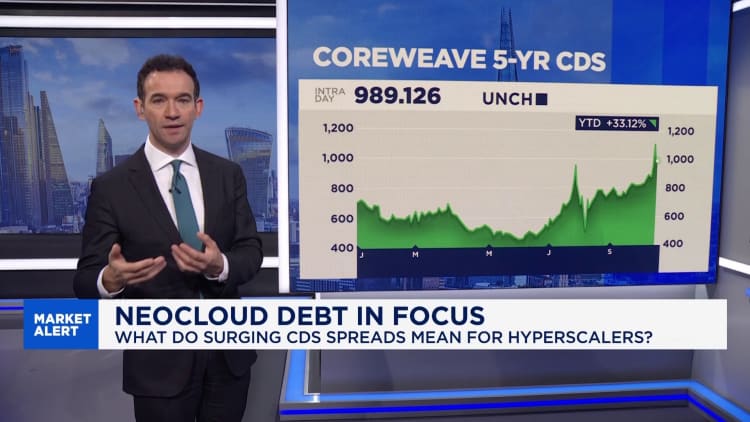
Investors have also grown concerned that tech companies are borrowing too much for the AI buildout. Shares of neoclouds like CoreWeave, which has seen its total debt rise to more than $51 billion, were down 10%, putting the stock’s week-to-date losses at more than 23%.
“The question is: Is this a systemic issue?” said Michael Rosen, Angeles’ chief investment officer. “Obviously, increased debt issuance is something to observe and continue to watch and be concerned about if it continues to get to levels of excessiveness. But we’re not remotely close to that right now.”
Other areas of the market such as energy saw gains Friday, with stocks like Chevron helping to keep the Dow’s losses in check. That’s as oil prices moved higher amid rising tensions between the U.S. and Iran as well as between Russian and Ukraine. West Texas Intermediate crude futures increased 2% to above $100 per barrel, while Brent crude futures advanced 3% to above $109.
Simultaneously, investors have been grappling with hotter-than-expected inflation data, which has been exacerbated by elevated energy prices in the wake of the U.S.-Iran war. Wholesale inflation this week saw its biggest gain since 2022, while consumer inflation remained well above the Federal Reserve’s target of 2%.
Fed Chairman Kevin Warsh spoke at an IMF event in Bangkok overnight. And while he didn’t comment on whether the Fed would raise rates before year-end, traders took that as a sign that the central bank will hold policy steady later this month. The CME Group’s FedWatch tool points to an 85% chance the Fed keeps its overnight rate unchanged at its Oct. 27-28 meeting.
Communication services, information technology lead S&P 500 lower
Communication services and information technology led the S&P 500 lower on Friday.
The two sectors were down 2.7% and 2.4%, respectively, becoming the two biggest laggards among the 11 S&P 500 sectors. Consumer discretionary followed behind them, falling 1.5%.
However, a look beneath the surface showed that the S&P 500 — which was last down 1.3% — was more evenly split despite the losses at the index level. There were about 280 losers in the index and 222 gainers.
In total, five out of the 11 S&P 500 sectors were in positive territory, led by energy with its 2.1% gain and utilities with its rise of 1.2%.
— Sean Conlon and Sarah Min
U.S. crude oil surpasses $100
U.S. crude oil prices rose sharply Friday as Iran escalated its attacks in the Strait of Hormuz this week and Ukraine vowed to keep striking Russian refineries.
U.S. West Texas Intermediate futures were up 2.9% to $100.78 per barrel. Brent crude, the international benchmark, was 3.3% higher at $109.37 per barrel. Read more.

— Spencer Kimball
Moog, Fox Factory among the stocks making big moves midday
Here are the stocks making moves in midday trading:
- Independent Bank — Shares of the Michigan-based bank holding company jumped almost 5% after third-quarter earnings surpassed estimates. Independent Bank earned $1.90 per share, topping the FactSet consensus call for $1.85 per share. Net interest income of $220.7 million also beat the $218.5 million estimate. The bank sees home equity loans growing by a high single-digit annualized percentage in the fourth quarter.
- Moog — The manufacturer of precision motor control systems rose more than 4%. Morgan Stanley upgraded shares to overweight from equal weight. The firm also lifted its price target to $448 from $405, suggesting about 23% upside from Thursday’s close. Shares have been on a tear in 2026, up more than 55%.
- Fox Factory — The vehicle suspension maker tumbled 9% after CEO Mike Dennison stepped down from his role. Fox’s board appointed Douglas Grimm as interim chief executive. The company also trimmed its full-year revenue outlook.
Read the full list here.
— Deena Zaidi
Where investors are looking next after the pullback in semiconductors
Early in the “SaaSpocalypse” that roiled software companies this year, Manish Gupta, a portfolio manager at First Eagle Investments, added to Workday as he parsed through the wreckage for some bargains.
In recent months, that bet has paid off for the value investor. After falling about 40% in the first quarter of 2026, during which the enterprise software stock at various points was trading at not even three times revenue, the stock went on to surge more than 55% in the third. It’s also outperforming this week, rising more than 2% amid a broader tech sell-off as investors exit for safer assets.
Gupta, who attended the company’s analyst day this week, remains confident in Workday, which he said is trading at a discount to similar businesses in the private markets. Workday is a top 10 holding in the First Eagle Global Fund (SGENX), which he co-manages and which had nearly $75 billion in total net assets as of Sept. 30.
“The price has moved up, but the business has also become better,” Gupta said. “The ‘SaaSpocalypse’ has also turned around, but the stock’s still attractive.”
CNBC Pro subscribers can read more here.
— Sarah Min
Why Bank of America is in ‘risk-off’ mode for the next month
The near-term case against stocks is growing, according to Bank of America.
Strategist Michael Hartnett laid out four reasons why the bank is taking a “risk-off” approach for the next month:
- Higher yields and the “need for [the Federal Reserve] to hike on Oct. 28;”
- Elevated oil prices due to the wars in the Middle East and Ukraine;
- “Rising risk of ‘wave-like’ [Democratic] sweep midterms;”
- The recent price action in artificial intelligence-linked names
CNBC Pro subscribers can read more here.
— Fred Imbert
How the CoreWeave sell-off is affecting OpenAI vs. Anthropic valuations
The spread is widening between AI leaders OpenAI and Anthropic as a sell-off in CoreWeave leads neocloud stocks lower.
OpenAI’s valuation is down more than 4% the past 24 hours after briefly slipping under $1.5 trillion, according to perpetual futures pricing on decentralized exchange Hyperliquid. Meanwhile, Anthropic perps are up 2.4% over the same time period, recovering an overnight dip and indicating a valuation of just over $2 trillion.
Read the full story here.
— Oliver Renick
S&P 500 opens slightly higher
The S&P 500 kicked off Friday’s session in positive territory.
The broad market average moved up 0.1% just after 9:30 a.m. ET, while the Nasdaq Composite lost 0.2%. The Dow Jones Industrial Average added 188 points, or 0.4%.
— Sean Conlon
Wells Fargo urges caution on buying longer duration bonds
Wells Fargo Investment Institute isn’t buying longer-term bonds yet, despite the move lower in Treasury yields.
The firm doesn’t believe investors are still adequately compensated for the risks associated with extending duration, which is a measure of interest rate sensitivity.
“Financial conditions are tightening, long-term borrowing costs face upward pressure, and investors are increasingly demanding additional compensation to hold longer-maturity bonds,” said Darrell Cronk, president of Wells Fargo Investment Institute and chief investment officer of Wealth & Investment Management.
“Currently, we do not believe we have reached the peak in interest rates for this cycle, so caution is warranted.”
— Michelle Fox
Berkshire Hathaway seeks new ways to deploy capital with its recent investment in Bending Spoons, Morningstar says
Greg Abel, the new leader of Berkshire Hathaway “pushes into new territory” with the firm’s latest investment in Bending Spoons, an Italian-based private equity firm, Morningstar wrote Wednesday.
Abel, who took over as CEO in January, led a $330 million investment in Bending Spoons, following Berkshire’s $600 million investment from July, when the Italy-based serial acquirer went public on the Nasdaq.
“It is a sign that the firm is finally moving out of its comfort zone to find places to put capital to work,” Morningstar analyst Greggory Warren wrote.
The investments is already bearing fruit. As of Oct. 15, Berkshire is sitting on a nearly 80% gain on its investment in Bending Spoon, Morningstar noted, after shares rose in the days following the announcement of Berkshire’s additional stake.
— Paulina Likos
Stocks making the biggest moves premarket: Tesla, SpaceX, Alcoa, CoreWeave & more
Tesla shares climbed nearly 5% premarket after the EV maker unveiled its long-awaited second-generation Roadster on Thursday. The vehicle features SpaceX-developed rocket-style thrusters, giving investors another reason to focus on the overlap between Elon Musk’s companies.
SpaceX also rose after Evercore ISI raised its price target on the stock to $275 from $230, while reiterating an outperform rating, citing stronger AI and Starship catalysts. Tesla describes it as the world’s first flying car and expects production to begin in 2028.
The aluminum producer, Alcoa rose more than 2% after stronger quarterly results, while CoreWeave fell 4% premarket after the stock came under pressure this week as investors braces for higher interest rates that might impact the highly indebted company.
Read more here on companies making the biggest moves premarket.
— Deena Zaidi
Travelers falls despite earnings beat
Travelers shares were down 4% even after the company reported third-quarter results that beat analyst expectations. The insurance giant posted core third-quarter earnings of $9.18 per share on revenue of $12.48 billion. Analysts polled by LSEG expected a profit of $7.42 per share on revenue of $11.38 billion.
— Fred Imbert
Stocks on the move in premarket: CoreWeave down, Tesla up
CoreWeave shares were 4% lower in premarket at 4:40 a.m ET on Friday, following a rollercoaster session in which it tumbled on fears over its debt pile before ending higher.
U.S Treasury yields inch lower as investors digest hot inflation data
U.S. Treasury yields declined on Friday as investors weighed hotter-than-expected inflation data and Federal Reserve Chairman Kevin Warsh’s latest comments on interest rates.
Turbine maker Nordex pops 14% on guidance raise
Shares of renewable energy firm Nordex jumped nearly 14% in early deals after the company raised its earnings before interest, taxes, depreciation and amortization (EBITDA) margin guidance for full-year 2026 to 11.5% to 12.5% from 8% to 11%.
In a pre-results release, the Hamburg-based wind turbine maker also said it expected third-quarter earnings of 278 million euros ($312.3 million), up from 136 million euros the previous year and ahead of consensus expectations.
Nordex said performance was driven by higher margins in its services segment, strong project execution and previously flagged risks to its projects not being as severe as expected.
Citi analysts said the update should have a “positive knock-on effect on 2027 consensus estimates and beyond.”
“Nordex’s stock is, in our view, priced for outer-year earnings risk tied to the German outlook. While we think bears may stick with this view into Germany’s 2027 wind auctions, this update means that the earnings starting point is higher, making the outer-year decline implied by the current valuation even steeper,” they said in a Friday note.
— Jenni Reid
Asia markets close higher as tech stocks bounce back
Japan’s Nikkei 225 closed 1.39% higher at 65,324.29, while South Korea’s Kospi rose 2.05% to 5,668.05.
Australia’s benchmark S&P/ASX 200 gained 1% to 8,806.70.
Hong Kong’s Hang Seng index was up 0.51% in the last hour of trade on Friday, while mainland China’s CSI 300 closed 0.11% higher at 4,170.61
— Justina Lee
European stocks open higher, tech rebounds
European equity markets were mostly higher at Friday’s open, with the regional Stoxx 600 index up 0.3% in early deals.
The technology sector rose 0.7%, rebounding from its 1.48% decline on Thursday amid global concerns about debt levels in AI-linked firms.
German blue chips were up 0.43%, though London’s FTSE 100 slipped 0.26%. U.K. lenders Lloyds and Natwest were both around 2% lower following reports that the upcoming budget will contain tax hikes on banks.
— Jenni Reid
South Korea’s Kospi logs worst week since 2008, dropping over 14% on AI worries
South Korea’s benchmark index Kospi ended the week 14.5% lower to mark its worst performance since October 2008, as index heavyweights Samsung and SK Hynix tumbled nearly 20% and 25%, respectively.
That comes against the backdrop of a sharp drop in chip names globally this week amid concerns over continued funding for the artificial intelligence boom, intensifying competition and also a possible chip supply glut in a few years.
On the day, the Kospi gained 2%, snaping a seven-session losing streak. The index has lost almost 40% since its June high and is firmly entrenched in bear market.
— Vinay Dwivedi
Global bond yields continue to ease
Government borrowing costs around the world were slightly lower on Friday, as the recent global sell-off continues to cool.
The U.S. 10-year Treasury yield fell 10 basis points on Thursday, taking its weekly decline to around 15 basis points, according to LSEG data. It was around 1 basis point lower on Friday. Yields move inversely to prices.
German, French and U.K. yields were also marginally in the red. The 10-year yields on their bonds have all fallen between 7 and 8 basis points this week.
Investor nerves over governments’ mounting debt piles and a lack of fiscal consolidation have driven many yields to the highest level in decades, but the sell-off has eased amid lower oil prices and following a strong U.S. Treasury auction.
Loading chart…
— Jenni Reid
Hybe shares jump 10% as K-pop sensation BTS’ tour lifts earnings hopes
Shares of Hybe, the company behind K-pop supergroup BTS, surged 10% on Friday as investors weighed an upbeat third-quarter earnings outlook fueled by its artistes’ global concerts.
Hybe’s third-quarter revenue is expected to reach 1.5 trillion won ($1.11 billion), up 106% from a year earlier, while operating profit is projected at 172.2 billion won, according to local brokerage firm iM Securities. Concert revenue is expected to come in at 717 billion won, nearly tripling from a year earlier.
The share price gain on Friday outperformed the broader Kospi, which rose 2.9%.
BTS’ ongoing world tour featured 16 stadium shows in North America and eight in Europe during the third quarter.
— Jenny Lee and Lim Hui Jie
Indonesia’s benchmark index falls 8% as MSCI considers market downgrade
The Jakarta Composite fell 8% in early trading as MSCI is considering to reclassify Indonesian indexes from emerging to standalone market status
The news is a major setback to Indonesia’s benchmark index, already among the worst performers globally this year, as standalone status will exclude it from major indexes, preventing flows from passive funds.
Index provider MSCI said that it will make its final decision by the end of June 2027.
— Justina Lee
SK Hynix, Samsung gain as Asian tech stocks bounce back
Asian technology stocks rose Friday, recovering from sharp losses in the previous session on concerns over AI financing and rising competition in the chip sector.
In Japan, SoftBank Group advanced 1.92%, while chip equipment maker Tokyo Electron rose nearly 2% higher. Advantest added 1.89% and Japanese memory chipmaker Kioxia surged 6%.
In Hong Kong, Alibaba added 3.1% higher and Tencent rose 2.2%.
In South Korea, SK Hynix gained 2.85% and Samsung Electronics rose 2.38%. Meanwhile, the country’s finance ministry is looking to step up market monitoring after the benchmark Kospi index fell nearly 8% on Thursday, Reuters reported.
— Justina Lee
Mainland China, Hong Kong indexes open higher
Mainland China and Hong Kong indexes rose Friday, as Asian markets staged a recovery after a sell-off in the previous session.
Hong Kong’s Hang Seng index advanced 1.27%, while the Hang Seng Tech index gained 2.16%. Mainland China’s CSI 300 was 0.30% higher.
The gains in Hang Seng were led by educational services and healthcare sectors, up 3.17% and 2.52%, respectively.
— Justina Lee
Asia-Pacific markets open higher as investors assess AI prospects
Asia-Pacific markets traded higher early Friday.
Japan’s Nikkei 225 added over 1% while the Topix rose 1.14%.
The Kospi advanced 1.22% at open, and the small-cap Kosdaq gained 1.28%.
Australia’s benchmark S&P/ASX 200 was 0.83% higher.
— Justina Lee
Japan’s Nikkei 225 is set to rise after Thursday rout, tracking Wall Street gains
Asia-Pacific markets were set to open higher on Friday, tracking gains in U.S. stocks.
Japan’s Nikkei 225 was poised to rise, with the Chicago futures contract at 65,460 and its Osaka counterpart last trading at 65,520, compared with the index’s previous close of 64,425.95.
Hong Kong Hang Seng index futures were at 24,274, compared with the index’s last close of 24,062.72.
Australia’s S&P/ASX 200 was 1.02% higher in early trade.
A potential recovery in Asia stocks comes following a sharp rout on Thursday as investors soured on artificial intelligence plays amid concerns over financing, increased competition and possible oversupply of chips in a few years.
— Justina Lee
Interactive Brokers, J.B. Hunt and Varonis Systems among the stocks making moves after the bell
Check out the companies making headlines in after-hours trading:
- Interactive Brokers – Shares of the electronic broker fell 1% after the company’s third-quarter earnings missed analyst expectations. Interactive Brokers reported adjusted earnings of 67 cents per share, just below the 68 cents per share that analysts surveyed by LSEG were expecting. Revenue, however, topped expectations, coming in at $1.91 billion versus the consensus estimate of $1.87 billion.
- J.B. Hunt Transport Services – The stock shed more than 2% following the company’s latest quarterly results. For the third quarter, J.B. Hunt earned $1.82 per share, missing the $1.89 per share that analysts were looking for. The company also posted $3.68 billion in revenue, which exceeded the $3.57 billion that was expected.
- Varonis Systems – The artificial intelligence security company’s stock gained more than 2% after Proofpoint announced that it will be acquiring the company in an all-cash deal valued at roughly $6.3 billion. The deal is expected to close in the first half of 2027.
Read here for the full list.
— Sean Conlon
Stock futures open little changed
U.S. equity futures were trading around the flatline on Thursday evening.
S&P 500 futures traded down 0.04% just after 6 p.m. ET, while Nasdaq-100 futures shed about 0.2%. Futures tied to the Dow Jones Industrial Average added 7 points, or 0.01%.
— Sean Conlon