

- IEA members will release diesel supplies equivalent to less than one day of global demand or about five days of U.S. consumption.
- The Trump administration has pushed Europe to release diesel stocks as fuel prices surged ahead of the U.S. midterm elections.
- The IEA diesel release does not address how to increase refining capacity, analysts say.
International Energy Agency members have agreed to release more than 20 million barrels of diesel “as soon as possible” as fuel prices surge globally, the group said in a statement Thursday.
President Donald Trump said earlier this month that Europe had agreed to deploy a “massive amount of their heavily stocked Diesel Oil.” The release detailed by the IEA on Thursday is equivalent to less than one day of global diesel demand or slightly more than five days of U.S. consumption.
The IEA did not specify a timeline for the release in its Thursday statement. The Group of Seven nations led by France said on Oct. 2 that they would deploy substantial diesel stocks over 20 days. If that is the case, the IEA members would supply about 1 million barrels each day for almost three weeks.
Diesel futures are trading more than 1% lower Thursday at $4.86.
The IEA, headquartered in Paris, has more than 30 member states, including the U.S. and key European and Asian allies. The agency, created in 1974 in the wake of the Arab oil embargo, is tasked with maintaining energy security by deploying oil stockpiles in response to crises like the wars in the Middle East and Eastern Europe.
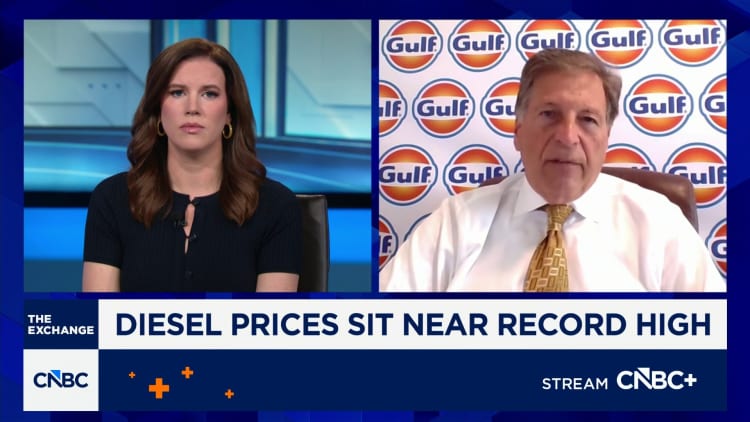
The Trump administration has pushed Europe to release diesel inventories as prices in the U.S. surged to record highs in September. The retail price of diesel stood at an average $6.32 per gallon Thursday, more than 70% above the same period last year, according to AAA.
Trump is facing political pressure to address fuel prices ahead of the U.S. midterm elections on Nov. 3. The president struck a diesel deal with Russia last week that analysts have said will do little to reduce prices.
The G7 nations, led by France, announced earlier this month that they would deploy stocks through the IEA in response to the diesel crisis but did not give specific quantities.
The IEA release does “not solve the basic problem which is how to increase production at refineries which are damaged in the Middle East or Russia, and operating at capacity in the USA,” said Andy Lipow, president of Lipow Oil Associates.
Prices have surged as Ukraine has pounded Russian refineries and Iran and its Houthi allies have attacked energy facilities around the Persian Gulf.
IEA members agreed in March to deploy 400 million barrels of oil in response to the global supply disruption triggered by the Iran war. They have since agreed to release the remaining 100 million barrels pledged in March “in a timely manner consistent with national circumstances,” the group said Thursday.
IEA’s governing board said 330 million barrels have been released so far. Some members have deployed more than they originally pledged so the total release will exceed the 400 million barrels agreed in March.