

- The U.S. naval blockade of Iran has proven effective at slashing the country’s crude oil exports, a key source of its revenue.
- The Trump administration is betting that mounting economic pressure will eventually force Tehran to cut a deal.
- As Iran’s exports plunge, the U.S. military is helping Gulf allies ferry oil through the Strait of Hormuz.
Iranian crude oil exports have plunged in August as the U.S. relies on economic pressure through its naval blockade, rather than military strikes, to coerce Tehran into a deal to fully reopen the Strait of Hormuz.
Tehran has loaded about 260,000 barrels per day for export at its ports so far this month, a decline of more than 80% compared with 1.7 million bpd in August 2025, according to data shared Thursday by the trade intelligence firm Kpler.
President Donald Trump reimposed the blockade on July 14 in retaliation for Iran attacking oil tankers transiting the Hormuz Strait. Tehran’s crude loadings are down about 70% in August from 893,000 bpd last month.
Oil exports are a crucial source of revenue for Iran. The Trump administration believes Iran will eventually run out of money and have to capitulate, said Bob McNally, president of Rapidan Energy.
The blockade has been “very effective,” said Matt Smith, director of commodity research at Kpler. It has “walloped Iran’s crude export loadings,” he said. The crude that Tehran is able to load on tankers probably doesn’t make it past the blockade, Smith added.
Tehran has about 20 million barrels of crude oil on tankers in Asia waiting to discharge to China, the main recipient of Iranian oil, that is a source of revenue, Smith said. Iran can probably store another 20 million barrels onshore before it runs out of space and its production is affected, he said.
The U.S. military has redirected 75 commercial ships, disabled three vessels and boarded two as of Thursday to enforce compliance with the blockade, Central Command said in a social media post.
A campaign of economic warfare
Trump has shifted to a campaign of economic warfare against Iran, after a dozen waves of airstrikes in July failed to force Tehran to abandon its claim to control Hormuz. Treasury Secretary Scott Bessent on Monday announced a plan to sever the Islamic Republic’s financial connections around the world.
“We have the blockade and we are going to have the toughest sanctions in history,” Bessent told CNBC last Thursday. “It worked in Venezuela once we put up the blockade. It is working in Cuba right now and it is going to work in Iran, and we are going to collapse this regime.”
But the Treasury secretary’s launch of “Operation Economic Outcast” against Iran on Monday was light on specifics. The campaign represents a major departure in U.S. policy, said Jeremy Paner, who worked on Iran sanctions at the Treasury’s Office of Foreign Assets Control from 2007 to 2013.
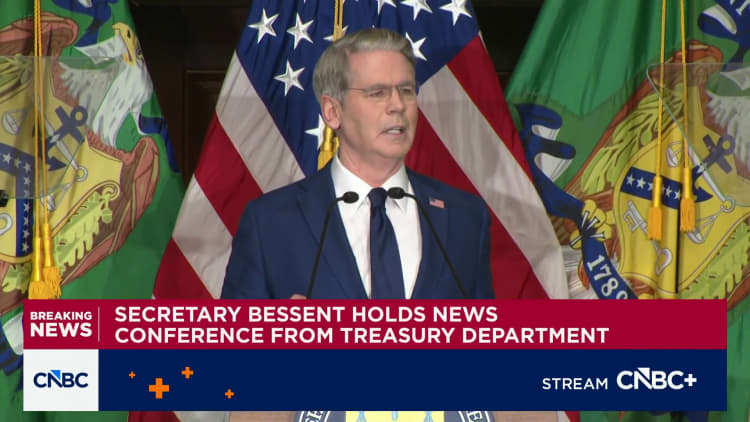
“Instead of saying we’re going limit the revenue, they’re saying we’re going to completely economically isolate Iran,” Paner said. “That had never been the goal of the U.S economic sanctions. Bessent saying that is a big deal.”
But Iran has remained defiant, rejecting U.S. demands and calling on the Trump administration to accept its conditions for Hormuz to reopen. Two tankers have come under attack this week in Hormuz and near Oman. Meanwhile, Tehran is negotiating with Oman to share control of the strait potentially with some type of fee, a system the U.S. and its allies reject.
But Iran is losing some of its leverage as the U.S. military helps tankers from allied Gulf nations transit Hormuz through a southern corridor along Oman’s coast, said Michelle Wiese Bockmann, senior maritime intelligence analyst at Windward.
Trump said Wednesday that the strait is functioning with 10 million barrels of oil exiting the waterway on Tuesday. Independent firms are seeing volumes that are much lower than the U.S. government’s figures.
Kpler tracks between 5 million bpd and 6 million bpd of crude oil transiting the strait, Smith said. This is around a third of the 15 million bpd of crude that exited before the war started on Feb. 28.
Windward estimates that exports through Hormuz rose to 5 million bpd in July compared with about 4 million bpd in June and 1.6 million bpd in May.
“My assessment is that it’s scaling and it’s scaling quickly despite the fact that Iran is placing enormous pressure on maritime security,” Bockmann said. “While this southern corridor scales, Iran loses its leverage,” she said.