

U.S. stock futures fell slightly Thursday after the Dow Jones Industrial Average dropped to a fresh 2026 low in the previous session, as inflation fears took hold on Wall Street.
Dow futures were down 55 points, or 0.1%. S&P 500 and Nasdaq 100 futures slipped 0.1% and 0.2%, respectively.
Brent crude futures, the international benchmark, surged 7% to $114.86 a barrel on Thursday. West Texas Intermediate crude futures were down 0.3% at $96.03 a barrel.
The spike in international oil follows an attack on Iran’s South Pars gas field by Israel. Iran then retaliated by hitting Qatari energy facilities. President Donald Trump warning more facilities in Qatar were attacked, the U.S. would “massively blow up the entirety of the South Pars Gas Field.”
Micron Technology shares lost 6% in premarket trading. A memory supply shortage helped the semiconductor company nearly triple its revenue in its most recent quarter.
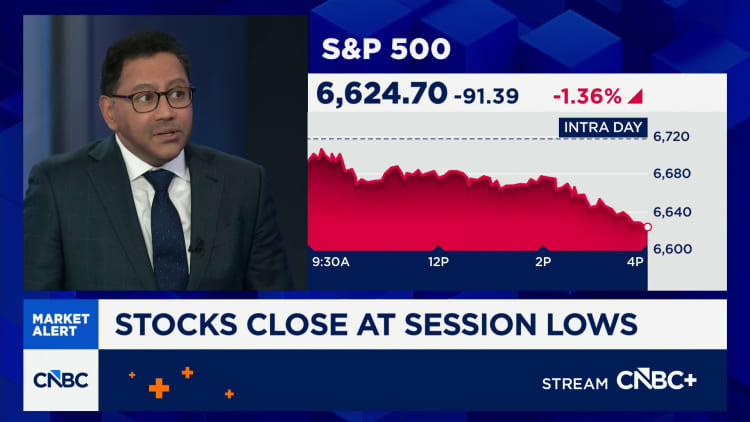
Wall Street is coming off a dismal trading session. On Wednesday, the 30-stock Dow tumbled some 768 points, or 1.6%, to a new closing low for the year. The benchmark, which also touched an intraday low for 2026, even closed below its 200-day moving average, a technical level suggesting the long-term trend for the index is now negative.
The S&P 500 sold off by 1.4%, while the Nasdaq Composite slid 1.5%.
The sell-off comes after a surprisingly hot producer prices report, and greater inflation expectations from the Federal Reserve, added to fears that the war in Iran could mean the U.S. economy is headed for a stagflation scenario — or a period of lower growth and higher pricing pressures.
It also lowered expectations for an interest rate cut, even with the Fed signaling one reduction is still coming this year. Markets were last pricing in a 52% probability that the central bank stays on hold in 2026, according to the CME FedWatch tool.
Investors remain hopeful that the stock market could right itself, given that the backdrop of strong corporate earnings and a resilient consumer remains constructive for equities. For the time being, the key overhang will remain the duration of the Iran war.
“The biggest uncertainty or unknown is, how long is this crisis going to last? Should it linger for much longer, then the related impact on inflation and potentially on growth is what will break the market,” Barclays head of U.S. equity strategy Venu Krishna told CNBC’s “Closing Bell: Overtime” on Wednesday. “But we are not there yet. That’s not our base case. You just have to keep your fingers crossed.”
On the economic front, the latest weekly jobless claims data is due out Thursday morning. The Philadelphia Fed Manufacturing Index is also set to release.
U.S. markets will open amid broad selling pressure in global markets, with stocks and bonds in the red across both Europe and Asia. The pan-European Stoxx 600 was down 1.8% in early trading in London, while Japan’s Nikkei, Hong Hong’s Hang Seng and South Korea’s Kopsi fell 3.4%, 2% and 2.7%, respectively.
Alibaba falls on revenue miss, big income drop

— Fred Imbert
European stocks slide as Iran war intensifies
The pan-European Stoxx 600 was down 1.7% on Thursday morning, following attacks on Iranian and Qatari energy infrastructure. The continent’s major bourses all slipped into the red and all sectors except for oil and gas sold off.
Basic resources was the hardest hit sector, with London-listed mining majors Antofagasta and Fresnillo each sliding more than 6%, as investors were rattled by inflation fears and surging energy prices that could squeeze margins in the sector.
Oil and gas prices surge on rising energy shock fears
Oil and gas prices surged as escalating attacks in the Middle East threatened long-term damage to major energy facilities.
International benchmark Brent crude futures with May delivery rose nearly 11% to $119.11 per barrel, while U.S. West Texas Intermediate futures advanced 3% to $99.29.
Gas prices were also sharply higher. U.S. natural gas prices jumped 5.1% to $3.22 per million British thermal units.
Meanwhile, the front-month gas price at the Dutch Title Transfer Facility (TTF) hub, a European benchmark for natural gas trading, was last seen trading 24% higher at 68.22 euros ($78.26) per megawatt-hour.
— Sam Meredith
Gold and silver sell off
Gold and silver joined a broad sell-off on Thursday, with the metals shedding 2% and 5.5% as fears about the Iran war and inflation gripped global markets.
At 5:36 a.m. ET, spot gold was down 2% at $4,718.60 an ounce. Front-month gold futures were down 3.8% at $4,709.90. Spot silver was 5% lower at $71.53 an ounce, while silver futures lost 7.7%, paring earlier losses to settle at $71.62. Read more.
— Chloe Taylor
Asia markets dip, with Japan leading losses
Asia markets dipped on Thursday, tracking losses on Wall Street as worries over Iran persisted.
Japan’s Nikkei 225 was down 2.58%, leading losses in Asia, while the broad-based Topix was 2.03% lower.
South Korea’s Kospi lost 2.54%, after being the top gainer in the region on Wednesday, while the small-cap Kosdaq saw a smaller loss of 1.69%.
Chip heavyweights Samsung Electronics and SK Hynix saw losses of over 3%.
Hong Kong’s Hang Seng index fell 1.62%, while the mainland Chinese CSI 300 index was 0.89% down.
Australia’s S&P/ASX 200 was down 1.56%.
— Lim Hui Jie
The duration of the U.S.-Iran war remains key overhang, Barclays’ Venu Krishna says
Investors remain optimistic that stocks can resume their upward march, given that strong corporate earnings and a resilient consumer is constructive for equities.
However, that will hinge on how long the U.S.-Iran war lasts, according to Venu Krishna, head of U.S. equity strategy at Barclays.
“The biggest uncertainty or unknown is, how long is this crisis going to last? Should it linger for much longer, then the related impact on inflation and potentially on growth is what will break the market,” Krishna told CNBC’s “Closing Bell: Overtime” on Wednesday. “But we are not there yet. That’s not our base case. You just have to keep your fingers crossed.”
— Sarah Min
Micron shares slip after latest results
Micron said revenue almost tripled in the latest quarter as results topped analysts’ estimates. The stock slipped 4.6% in extended trading.
Here’s how the company did relative to LSEG consensus:
- Earnings per share: $12.20 adjusted vs. $9.31 expected
- Revenue: $23.86 billion vs. $20.07 billion expected
— Katie Tarasov and Jordan Novet
Dow closes below 200-day moving average, S&P 500 nears its own
The Dow Jones Industrial Average closed below its long-term trend on Wednesday, and the S&P 500 could be next.
The Dow Industrials closed below its 200-day moving average for the first time since June 20, 2025, suggesting the underlying trend for the index is now negative.
The S&P 500 is fast approaching its own key support level, and will bear watching over the next trading session. On Wednesday, the broad market index closed just a few points above its 200-day moving average level of 6,615.70. It has not closed below that threshold since May 9, 2025.
— Sarah Min and Gina Francolla