

Stock futures inched higher Friday, while crude prices slipped, as traders monitored the conflict in the Middle East and the fragile ceasefire between Iran and the U.S.
S&P 500 futures and Nasdaq 100 futures rose 0.1%. Futures tied to the Dow Jones Industrial Average were up 81 points, or 0.2%.
West Texas Intermediate futures lost more than 2% to trade at $86.89 per barrel. Brent crude dropped 2% as well to $91.80. The moves come after Iran’s armed forces reportedly launched missiles late Thursday, while President Donald Trump mulled over a potential ceasefire extension.
Stocks are coming off a record-setting session after the U.S. and Iran agreed to Iranian negotiators agreed on a 60-day memorandum of understanding to extend the ceasefire.
However, Kate Moore, chief investment officer at Citi Wealth, believes that the market’s rally to new heights may continue to be dictated more by strong earnings growth versus headlines about any Middle East tensions.
“I think a lot of the snapback we saw since the lows in March was this acceptance that there was going to be a resolution at some point, but obviously the scope of that and the timing of that is still anybody’s guess,” she said on CNBC’s “Closing Bell: Overtime” on Thursday afternoon. “I really do think what’s been driving the market higher is, frankly, the power of the technology earnings … this has been happening company after company throughout the course of this earnings season.”
All three major indexes are on pace to end the week higher, with the tech-dominant Nasdaq Composite in the lead with a gain of more than 2%. The S&P 500 has risen more than 1% on the week, while the blue-chip Dow is sitting with a gain of less than 1%.
Friday marks the final trading session of May, and all three major averages are on pace for gains. The S&P 500 is up nearly 5%, while the Dow is on track for a 2% advance. The Nasdaq is outperforming, heading for an 8% advance for the month.
In extended trading, shares of Dell Technologies surged 38% after the laptop maker raised its full-year guidance and reported a first-quarter beat on both the top and bottom lines.
— CNBC’s Kevin Breuninger contributed reporting.
South Korea’s Kospi, Japan’s Topix hit record highs as investors shrug off Iran tensions
Asia-Pacific markets rose on Friday, with South Korea’s Kospi hitting a fresh intraday record and Japan’s Topix reaching a new all-time high, as investors looked past renewed military activity involving Iran and focused on gains in technology shares and record closes on Wall Street.
South Korea’s Kospi jumped more than 3% to close at 8,476.15, hitting a new intra-day high before paring gains slightly. The small-cap Kosdaq was down 2.68% to 1,074.8.
Japan’s Nikkei 225 was up 2.53%, ending the trading day at 66,329.5 while the Topix rose 1.41% to a new record high of 3,957.17.
Shares of Samsung Electronics surged over 5% after the company said it had begun shipping samples of its latest high-bandwidth memory chip to its customers globally.
In Australia, the S&P/ASX 200 rose 1.62% to close at 8,731.7. Hong Kong’s Hang Seng index added 0.55% in the final hour of trade, while the CSI 300 lost 0.45% to 4,892.12. India’s Nifty 50 dipped 0.5%.
— Lee Ying Shan
Innovent Biologics shares rise following pact with Pfizer of up to $10.5 billion
Shares of Innovent Biologics rose 10% after the company entered into a deal with pharmaceutical giant Pfizer to develop oncology medicines.
Innovent will receive an upfront payment of $650 million and is eligible for up to $9.85 billion in development, regulatory and commercial milestone payments, bringing the total value of the deal to up to $10.5 billion.
“Additionally, Innovent will receive up to double-digit royalties on sales of each product if approved,” the company said, adding that closing of the transaction is subjected to regulatory approvals.
Read the full story here.
— Justina Lee
LG Electronics’ shares surge 24% after announcing automotive innovations built with technology from Google
Shares of LG Electronics surged as much as 23.95% after the company announced a series of automotive innovations built with technology from Alphabet Inc.‘s Google.
The South Korean company said its new range of solutions is built on Android automotive operating systems.
The technology would support automakers to “significantly reduce the cost of deploying multi-display in-cabin systems.”
Read the full story here.
— Justina Lee
Samsung’s shares jump after company ships next-generation AI memory chip samples
Shares of Samsung Electronics rose as much as 6.51% after the company said it had begun shipping samples of its latest high-bandwidth memory chip to its customers globally.
Samsung’s 12-layer HBM4E chip, which it described as an industry first, can reach speeds of up to 16 Gigabits-per-second “with improved energy efficiency and thermal performance.”
The South Korean chipmaker added that there are plans to expand the lineup to include an 8-layer 32GB and a 16-layer 64GB configuration, depending on customer requirements.
Read the full story here.
—Justina Lee
Asia markets rise as investors weigh Iran military activity against signs of temporary U.S.-Iran deal
Asia-Pacific markets traded higher on Friday as investors weighed fresh military activity involving Iran against signs that Washington and Tehran were moving closer to a temporary agreement to halt their three-month conflict.
Japan’s Nikkei 225 rose 0.88%, while the Topix added 0.53%. South Korea’s Kospi jumped 2.68%, while the small-cap Kosdaq was up 0.25%. Shares of Samsung Electronics surged as much as 6.51% after the company said it had begun shipping samples of its latest high-bandwidth memory chip to its customers globally.
In Australia, the S&P/ASX 200 rose 0.72%.
Hong Kong’s Hang Seng index added 0.68%, while the CSI 300 rose 0.38%.
Iran’s armed forces reportedly fired missiles at unspecified targets late Thursday, according to state media outlet Fars.
— Lee Ying Shan
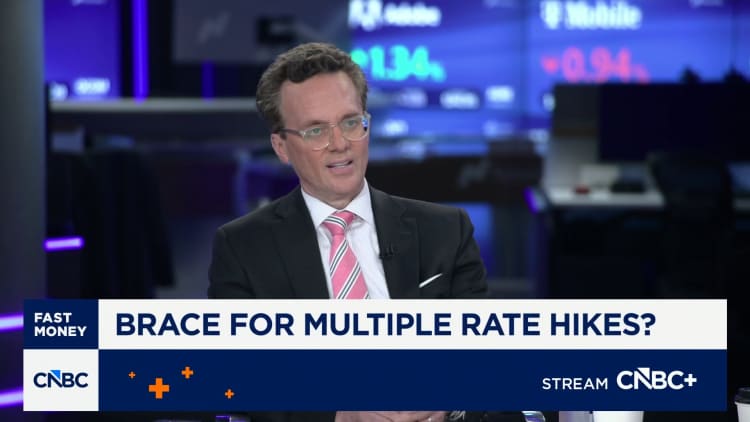
Former Trump economist says inflation data reinforces need for Fed to hike rates this year
Following Thursday morning’s release of April’s personal consumption expenditures price index, or PCE, a former Trump economist is making the case for the Federal Reserve to hike interest rates this year.
April’s PCE index reading showed that headline inflation was the highest since May 2023. For the core PCE reading, which excludes volatile food and energy costs, the annual level was the peak since November 2023.
“And, of course … these equity averages are at all-time highs; credit spreads are super tight; the dollar is high, but not excessively high. There’s no tightening of financial conditions, and the inflation numbers — the three- and six-month change show inflation moving up towards 4%. So, what’s going to force that back to 2%? It won’t happen magically,” said Joe Lavorgna, SMBC Americas chief economist and former counselor to Treasury Secretary Scott Bessent on CNBC’s “Fast Money” Thursday afternoon.
He added: “If the economy is growing reasonably well and inflation is moving further away from target, why wouldn’t [Fed chair Kevin Warsh] be hiking?”
— Lisa Kailai Han
Stocks making the biggest moves after the bell: Dell Technologies, American Eagle Outfitters and more
These are the stocks moving the most in extended-hours trading:
Read the full list of stocks moving here.
— Lisa Kailai Han
Stock futures open little changed
Stock futures opened little changed on Thursday evening.
Shortly after 6 p.m. ET, futures tied to all three major averages were trading near flat.
— Lisa Kailai Han