
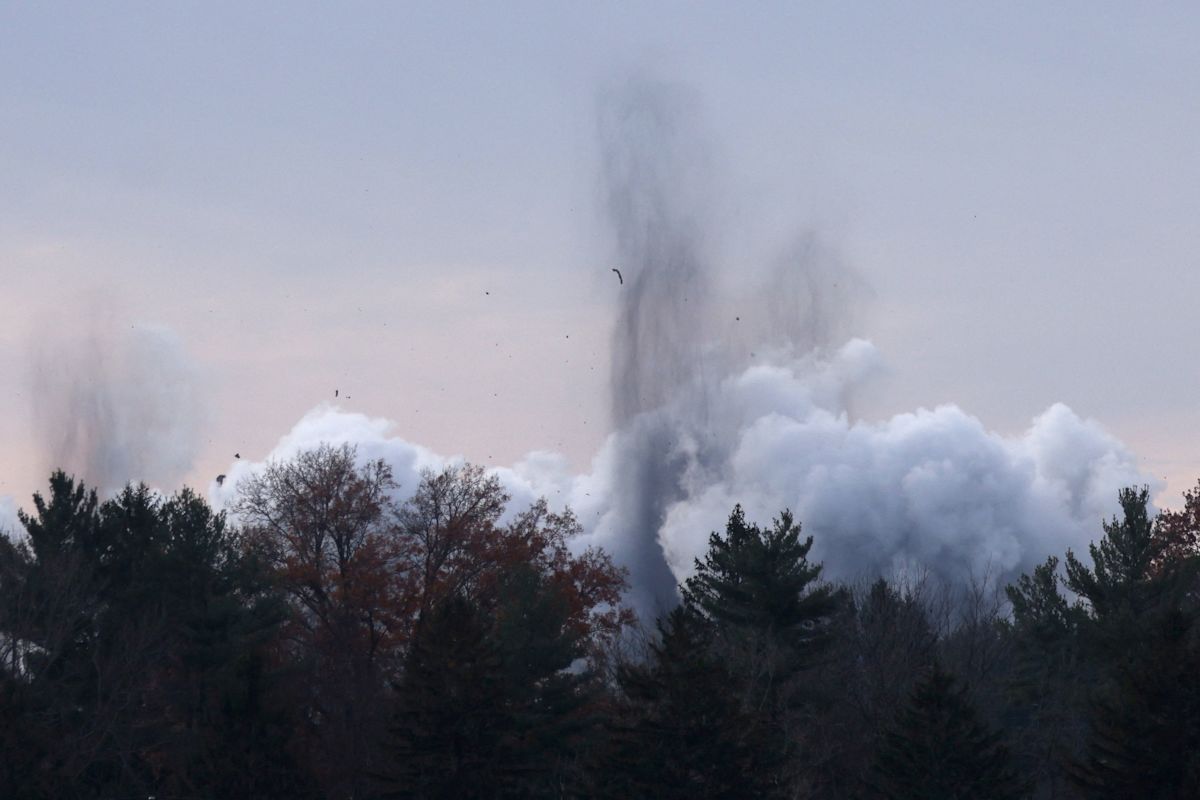
The Federal Emergency Management Agency (FEMA) issued an “all clear” notice around a U.S. Army facility in Iowa after the nation’s entire stockpile of lead azide, a chemical used to make explosives, was blown up in a controlled detonation Wednesday.
The blast, which took place at 10 a.m. ET at the Iowa Army Ammunition Plant, went ahead after a federal appeals court cleared the way for the detonation amid concerns over the environmental impact of a potential toxic lead dust plume.
“FEMA has issued an All Clear around Iowa Army Ammunition Plant,” the U.S. Army said in a social media post Wednesday night, adding that there was “zero” airborne lead detected.
Advertisement
Advertisement
The Environmental Protection Agency said Thursday that its real-time air monitors had detected no airborne lead anywhere in the region since the blast. Crews have collected more than 1,000 air, water, soil and dust samples since the detonation, on top of 1,591 taken beforehand, and the first lab results could arrive as early as Friday, the agency said in an update.
On Thursday, EPA crews were sampling schools, playgrounds, day cares and churches in the area and running a second round of drinking water tests, the agency said.
Lee Zeldin, the head of the Environmental Protection Agency, said that while sensors near the blast site were showing no signs of lead, parents should still take precautions when they go outside. “Residents are encouraged to wipe down outdoor surfaces that children touch … such as play sets, railings and window sills with a wet cloth,” he said.
The blast, which transforms the explosive lead azide into elemental lead, was first scheduled for Nov. 20, but was postponed amid a court fight and public concern.
Advertisement
Advertisement
On Monday, a federal appeals court cleared the way for the detonation to go ahead after environmental groups sued to stop it. Scientists had also warned that much about the environmental impact was unknown.
The Army said detonating the stockpile as soon as possible was the safest option because it was degrading and might explode uncontrollably at any time as the weather cooled.
Officials worked to limit the impact of the detonation, with earthen barriers erected and foam and water poured onto a pair of bunkers holding the 5 tons of lead azide to absorb much of the blast.
The EPA said it had granted an emergency permit to detonate the stockpile because a “controlled detonation during optimal weather conditions and incorporating robust mitigation measures, compared to an uncontrolled explosion, significantly reduces the potential reach and concentration of lead dust landing on surfaces, such as homes and windows.”