


It was, for a while, considered one of those colorful quirks that crop up in the course of an election: the fact that not one but two candidates named Dan Sullivan will appear on the Nov. 3 ballot for U.S. senator from Alaska.
One Dan Sullivan — Dan S. Sullivan — is the state’s incumbent Republican senator. He is trying to fend off a fierce challenge from former Democratic Rep. Mary Peltola and secure a third term. The other Dan Sullivan — Dan J. Sullivan — is a retired teacher from a tiny fishing village along the Alaska Panhandle. He has never previously campaigned for public office, and he switched his registration from “unaffiliated” to “Republican” just before the deadline to run. (He has since switched back to unaffiliated.)
But now the situation seems to be getting more serious. At President Trump’s direction, the Justice Department last week sued in federal court to block certification of the election if Sen. Dan S. Sullivan loses, alleging that retired teacher Dan J. Sullivan is a Democratic plant whose purpose is to siphon away votes.
Advertisement
Advertisement
Then, on Wednesday, the New York Times published an extensive investigation that appears to substantiate that allegation, calling it “Democrats’ secret effort to stack Alaska’s ballot.”
“The Times has found, based on interviews and text messages, along with documents prepared for a potential lawsuit against the campaign, that not only did Ms. Peltola’s team work with people trying to recruit Mr. Sullivan to run for Senate, but the effort was much broader,” the paper wrote. “The group worked to coax other would-be spoilers into the race, to dilute the incumbent’s support and help catapult the Democrat to victory.”
In response to the report, Trump called for both Peltola and the “fake” Dan Sullivan to be removed from the ballot in a post on Truth Social.
The outcome of the legal dispute, if it moves forward, could have enormous national implications. Democrats need to win at least a few Senate races in historically Republican states to secure a majority in the chamber. Polls suggest Alaska is one of their best chances to turn a red seat blue. Given how close other races across the country appear to be, a legal ruling that erases a narrow Peltola victory could be the pivot point that allows the GOP to keep control of the Senate for the last two years of Trump’s presidency.
Advertisement
Advertisement
How did this happen, and where do things go from here? Here’s everything you need to know to catch up and make sense of the story.
How Alaska wound up with two Dan Sullivans on the ballot
Ballot-stacking — the process of recruiting a spoiler candidate to help your candidate win — isn’t unheard of in politics, and the Times says it’s “generally considered legal.”
But it’s a lot easier in Alaska than other states because of the unique way elections work there. When Peltola ran for reelection to the U.S. House in 2024, the state GOP backed an effort to help a second Democrat — an inmate who conducted his campaign from a New York prison — remain on the ballot. And during this year’s primaries, super PACs aligned with both parties “flooded the state with ads for fringe candidates” in an attempt to “dilute support for the mainstream candidates opposed by the groups,” according to an October Alaska Beacon report.
How is any of this possible? The Last Frontier sends the top four primary candidates to the general election regardless of party — then asks voters to rank them on Election Day in order of preference. This means that candidates can claim any party affiliation on the ballot without being vetted by parties themselves. (Dan J. Sullivan initially claimed to be a Republican.) It also means that as ,long as they finish in the top four, primary candidates don’t have to earn many votes to secure their very own ballot line on Nov. 3. (Dan J. Sullivan won 4,107).
Advertisement
Advertisement
For months, Republicans have questioned Dan J. Sullivan’s intentions and tried to get him tossed off the ballot. In June, the Alaska Supreme Court dismissed their arguments, ruling that neither state law nor the U.S. Constitution provided any legal basis for removing Dan J. Sullivan’s name.
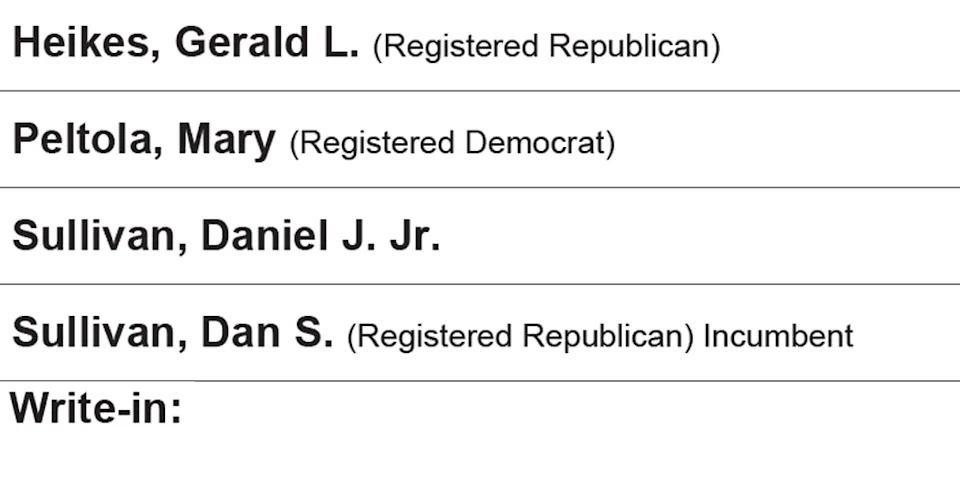
How the Senate candidates will appear on Alaska’s midterm ballot.
(elections.alaska.gov)The more obscure Sullivan has “maintained that he [is] running in good faith and of his own volition, as a moderate Republican and not a secret Democrat,” as a Times profile put it in August. He said he’d voted in the past for some Alaska Republicans, including Sen. Lisa Murkowski, even though he also “acknowledged previous donations to Ms. Peltola and a handful of other Democrats,” and said he would prefer Peltola for Senate over the Republican incumbent “if it was between those two.”
But according to this week’s Times report, “operatives aligned with” the Peltola campaign convinced Dan J. Sullivan to enter the race “to help Mary.” The report cited as its sources 12 people “who participated in or were told of the plan” as well as interviews with other would-be recruits and dozens of internal text messages.
For the record, both Peltola’s campaign and the Democratic Senatorial Campaign Committee, which directs the party’s campaign strategy in Senate races across the country, have denied any “involvement,” and Dan J. Sullivan did not respond to the Times’s repeated requests for comment. One of the Times’s main sources — former Peltola campaign manager and longtime aide Elisa Rios, who had been planning to file a wrongful termination lawsuit — also tried to retract her statements to the paper ahead of publication.
Advertisement
Advertisement
The Times story described an elaborate endeavor — which was “internally called the ballot composition project” — that “involved secret trips to far-flung Alaskan communities and the appearance of a mysterious Midwestern operative, who traversed the state using a fake name and made his pitch to would-be candidates over beers at brew pubs.” The Times also reported that the “Peltola campaign’s lawyers, as well as senior aides at the Democratic Senatorial Campaign Committee” were “involved” with the effort.
The Trump administration’s lawsuit
Legal battles over the dual Dan Sullivan issue had been confined to state courts until last week. That’s when Trump’s administration filed its lawsuit aiming to have the certification of the results blocked if Peltola wins a close election that may have been affected by Dan J. Sullivan’s presence on the ballot.
“Should Alaska certify any electoral results tainted by the inclusion on the ballot of Daniel J. Sullivan … the State and its officers will fail in its obligation to protect the integrity of its election,” the Department of Justice wrote in its legal filing.
“I’m the one that said do it,” Trump said Friday of the lawsuit.
Advertisement
Advertisement
The suit argues that a Democratic victory should be considered invalid if Peltola wins by a margin smaller than the total number of votes that Dan J. Sullivan receives — under the assumption that those votes may have come from confused voters who intended to vote for the incumbent Republican senator instead.
Democrats have asked the courts to dismiss the lawsuit, arguing that the administration lacks “any statutory or constitutional authority to insert itself” into the state’s electoral process. Alaska’s state government, which is currently led by Republicans, has also filed to dismiss the administration’s lawsuit. On Monday, a federal judge agreed to fast-track consideration of the dispute to potentially allow it to be resolved before Election Day.
Many legal experts say the lawsuit has a slim chance of success. First, it requires a very specific outcome in which Peltola wins by what would likely need to be a very thin margin. Even in that scenario, election law experts say, the appearance of confusion on the part of voters does not create legal grounds for the federal DOJ to have the results rejected.
“I believe that this lawsuit is abusive in its intentions and borders on frivolous in its arguments, and that it is destined for defeat in the courts should it reach the merits,” Walter Olson, a senior fellow at the Cato Institute, a libertarian think tank, told the Alaska Beacon.
Advertisement
Advertisement
Nicholas Stephanopoulos, a Harvard law professor, told the Harvard Gazette that the law the administration is relying on in its lawsuit — the National Voter Registration Act (NVRA) — does not give federal authorities any power to challenge state election procedures.
“The lawsuit has nothing to do with voter registration. There’s no allegation that anybody is improperly registered in Alaska; there’s no claim that Alaska isn’t in compliance with the NVRA’s requirements for voter registration,” Stephanopoulos said.
More generally, experts say the lawsuit runs against the Constitution’s language granting states the power to run their own elections.
“This is purely a matter of state law, and the administration has absolutely no authority to tell Alaska when or how to certify the results of its Senate election,” David Becker, a former Justice Department attorney who worked on voting rights cases, told Alaska Public Media.
What’s next?
The federal judge in Alaska considering Democrats’ motion to dismiss the lawsuit is expected to rule on whether Peltola’s campaign and other groups can join the case on Wednesday. If that motion is granted, the judge said the DOJ should be ready to respond to a motion to dismiss the case by Thursday afternoon.
Advertisement
Advertisement
That likely only matters in an extremely close race, which is not the recent norm in Alaska. The last time Dan S. Sullivan was on the ballot, he defeated his top challenger, independent candidate Al Gross, by 45,000 votes. The most recent Senate race, in 2022, was closer, but the top two finishers were both Republicans.
Things are expected to be much tighter this time around. Peltola has held a consistent lead in the polls since the summer, but her advantage has steadily shrunk in the months leading up to Election Day. The most recent surveys have her ahead by 2 points, well within the margin for Sullivan to win. The Cook Political Report, one of the nation’s most respected election forecasters, lists the race as a toss-up. Another well-regarded forecaster, the Center for Politics, categorizes it as “leans Democrat.”