

The Dow Jones Industrial Average rose on Tuesday as blue-chip companies rolled out their latest earnings results and oil prices slid for another day.
The Dow traded 657 points higher, or 1.3%. Sherwin-Williams rose 8% on the back of better-than-expected results for Q2 to lead the benchmark higher. Beverage giant Coca-Cola popped 5% on a top- and bottom-line beat, plus a hike to its full-year outlook. The S&P 500 was last up 0.3%.
The Nasdaq Composite was little changed, as a rally in software stocks helped lift the tech-heavy index later in the session. The iShares Expanded Tech-Software ETF (IGV) popped almost 2%, as Microsoft jumped nearly 2% and Salesforce gained 5%. Chips continued to lag, however, with the VanEck Semiconductor ETF (SMH) off more than 3%, tumbling for a fourth straight day as Micron lost about 9% and AMD fell 7%.
Falling oil prices lent the market some support, as Iran discussed the Strait of Hormuz with Saudi Arabia and Oman. West Texas Intermediate crude futures fell 5% to about $78 per barrel. International Brent crude also shed more than 5%, last trading just below $84.
The market’s moves reflected a broader rotation that’s been taking place within the market in recent weeks in which so-called old-economy sectors are getting a boost while high-flying technology names are taking a hit.
The Technology Select Sector SPDR Fund (XLK) hit its lowest level since May 7. At the same time, the State Street Health Care Select Sector SPDR ETF (XLV) and Financials ETF (XLF) surged to record highs, led by gains in insurance stocks.
“It’s been a really broad-based rotation,” Ross Mayfield, an investment strategist at Baird, told CNBC. “This momentum unwind has been a story that’s been playing out for six to eight weeks now, and it has a lot more to do with the technicals of the market than any fundamental changes.”
However, that rotation into more cyclical and occasionally rate-sensitive sectors such as consumer discretionary will depend on oil prices and interest rates staying around their current levels, he said.
“It’s hard to make a full case for you know consumer discretionary or financials or industrials continuing to catch a bid if rates are heading higher across the curve and oil is pushing up towards $100 a barrel.” Mayfield said.
A Federal Reserve rate decision is due Wednesday. Investors expect that the central bank will remain on hold, but will seek greater clarity on the path forward for monetary policy. Fed funds futures were last pricing in a quarter point hike in September, according to the CME FedWatch Tool.
Tech earnings remain top of mind for investors this week, as traders await results from Amazon, Apple, Meta Platforms and Microsoft.
Consumer confidence index slipped in July
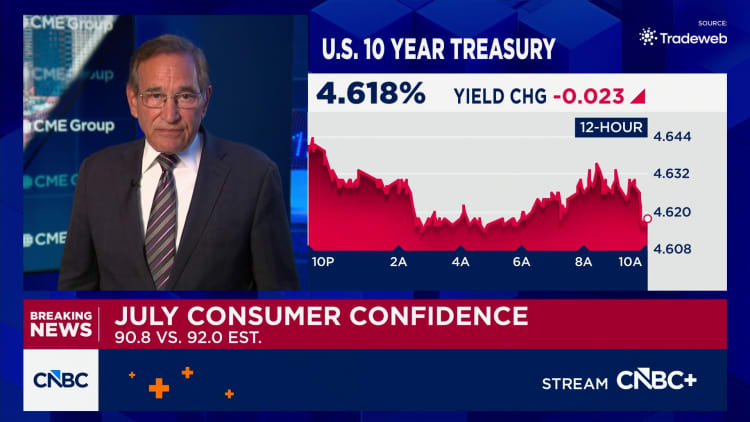
Consumer sentiment softened slightly in July as consumers continued to worry about inflation and grew more pessimistic about the labor market, the Conference Board reported Tuesday.
The board’s monthly Consumer Confidence Index edged lower to 90.8, down from June’s upwardly revised 92.2 and below the Dow Jones consensus for 92.0. The survey period included elevated tensions in the Middle East and rising oil prices.
The survey narrative noted that references to oil and gas costs eased but were still “elevated.” At the same time, the survey’s closely watched labor indicators showed a bit more concern — 24.6% said jobs were “plentiful,” down from 25.5%, while those saying jobs were “hard to get” nudged lower to 21.5%, or a 0.2 percentage point decline from June.
—Jeff Cox
Sandisk now off 50% from its all-time highs
Shares of flash storage memory company Sandisk are now off 50% from their June highs.
Sandisk closed at $2,335 on June 25, as the stock soared more than 850% up until that point in 2026 on the artificial intelligence-induced memory shortage. But in early trading Tuesday, the stock was off more than 14% trading at around $1,090, representing a 53% decline in just over a month.
While investors poured into memory names in the first half of 2026, they’ve been more skeptical in recent weeks, leading to a series of sell-offs in the group and chipmakers more broadly.
Even with the recent decline, Sandisk remains the best-performing stock in the S&P 500 for the year, up more than 360%.

— Davis Giangiulio
Health care, financials hit intraday all-time highs
— Sarah Min
RBC sees potential Tesla-SpaceX combination
Analysts at RBC Capital Markets believe the Terafab collaboration would be the most tangible near-term source of synergy, with potential chip cost savings of over $1 trillion by 2050.
“A potential Tesla/SpaceX combination would create a compelling ‘vertical integration from orbit to ground’ ecosystem spanning connectivity, autonomous vehicles, and humanoid robotics that could be difficult to replicate,” RBC analyst Tom Narayan said in a research note.
Terafab is a massive, vertically integrated semiconductor manufacturing joint venture led by Tesla, SpaceX and xAI, and aims to produce over one terawatt of custom AI compute capacity annually.
Reiterating its Outperform rating, the RBC analyst has a price target of $480 for Tesla, implying 55% upside from Monday’s close.
“We believe $480/share is a price at which Tesla shareholders should be receptive to a deal. While a potential deal timing would remain uncertain given SpaceX’s 44% decline from its June peak, we believe the long-term growth potential and synergies from a combination remain compelling,” the analyst noted.
— Deena Zaidi
Dollar index hits highest level in a month, Gold falls
The U.S. Dollar Index was trading as high as 101.64 on Tuesday, hitting levels it hasn’t crossed since since June 25.
At the same time, gold futures for August delivery tumbled more than 1% to hit a low of 4,016.5.
The stronger dollar comes as the Federal Reserve starts its two-day meeting on Tuesday, with a decision on interest rates set to be delivered on Wednesday.
— Gina Francolla & Davis Giangiulio
Major averages diverge at the open
The Dow Jones Industrial Average traded 335 points higher, or 0.6%. Sherwin-Williams rose more than 7% on the back of better-than-expected results for Q2 to lead the benchmark higher. Fellow-Dow member Coca-Cola also gained more than 4% following an earnings beat.
The S&P 500 was little changed on the day, while the Nasdaq Composite shed 0.7%.
— Fred Imbert
Visa to cut roughly 7% of staff, reports says
Visa is slashing 2,600 jobs, or about 7% of its workforce, Bloomberg reported Tuesday.
The cuts will primarily affect technology and product teams at the payments company, according to a staff memo from CEO Ryan McInerney reviewed by Bloomberg.
The layoffs come after startup payments Block laid off nearly half of its staff earlier this year.
Visa is slated to report its third-quarter earnings after the bell on Tuesday.
— Liz Napolitano
Boeing reports bigger loss than expected for second quarter
Boeing reported a wider-than-expected loss for the second quarter as the aircraft manufacturer’s long-delayed Air Force One program weighed down results.
Boeing took a $280 million loss on the program to deliver two 747s that will serve as the next-generation Air Force One aircraft to the U.S. government as it said it ramped up investment for that plane. It said it still expects the first delivery in 2028.
“While we’re making progress on our development programs, you’re never done until you’re done,” CEO Kelly Ortberg said in a note to staff.
— Leslie Josephs
J&J to pay $5.5 billion to settle lawsuits claiming its products caused cancer
Johnson & Johnson said it will pay $5.5 billion to settle 76,000 lawsuits that claim the company’s powder and talc products led to ovarian cancer, according to the company’s statement from Monday.
The deal can only happen if it’s accepted by at least 95% of the claims in state and federal court.
The company’s vice president of litigation said the “claims lack scientific merit” but prefers to settle the lawsuits “to put this matter behind.”
The company plans to pay $3 billion in 2027, with no additional payments before 2028, according to J&J’s statement.
“We got a fair settlement, and our clients are going to be happy with it,” said Chris Seeger, an attorney representing over 2,000 clients to Reuters. Seeger said J&J may need to pay $7 billion or more as the settlement does not cap the company’s payout.
J&J’s shares were up by over 2.5% during premarket trading.
— Ananya Chetia
UPS beats estimates, raises full-year guidance
United Parcel Service Inc reported revenue of $22.8 billion on Tuesday, beating Wall Street’s estimated $21.81 billion.
Adjusted earnings per share for the company were $1.76, against $1.66 per share. The delivery giant expects full-year revenue of $91.2 billion and adjusted EPS of about $7.22.
“Our second-quarter results marked an expected and significant shift in our performance and we delivered both consolidated revenue and non-GAAP adjusted operating profit growth,” CEO Carol Tomé said in a release. “We entered the second half of the year with strong momentum and are raising our full-year consolidated revenue, non-GAAP adjusted operating profit and non-GAAP adjusted diluted EPS guidance.”
— Deena Zaidi
Coca-Cola beats estimates, raises full-year outlook
Coca-Cola posted second-quarter earnings on Tuesday that topped expectations as strong demand lifted global volume growth.
Adjusted earnings were 97 cents per share, beating estimated earnings per share of 93 cents. The company reported revenue of $13.38 billion against expected $13.16 billion.
The company also raised its full-year forecast and now projects comparable earnings per share growth of 9% to 10%, up from its prior estimate of 8% to 9%.
“We delivered another strong quarter by staying close to the changing needs of our consumers and customers,” said Henrique Braun, CEO of The Coca-Cola Company. “While we continue to see a dynamic consumer landscape, we leveraged our powerful brands and system to gain value share, delivering revenue, profit and earnings growth while also investing for the long term.”
— Deena Zaidi
Stocks making the biggest moves premarket
Check out the companies making headlines before the bell.
Coca-Cola — Shares popped 2% after the beverage company topped earnings expectations and hiked its full-year outlook. Coca-Cola posted adjusted earnings per share of 97 cents, more than the 93 cents anticipated by analysts polled by LSEG. Revenue of $13.38 billion also exceeded the $13.16 billion expected.
Sherwin-Williams Company — The paint manufacturer rose nearly 6% after reporting second-quarter results that beat the Street. Sherwin-Williams earned an adjusted $3.70 per share on revenue of $6.79 billion. Analysts polled by FactSet expected a profit of $3.52 per share on revenue of $6.6 billion. The company also hiked its full-year earnings outlook.
Johnson & Johnson — The health and pharma giant rose more than 2% after it agreed to settle thousands of lawsuits alleging some of its talc products caused ovarian cancer. J&J will pay a combined $5.5 billion to resolve the lawsuits.
— Sarah Min
Wells Fargo downgrades Levi Strauss
Levi Strauss has delivered the upside that Wells Fargo expected. Now, analysts at the bank are turning cautious, and shares are sliding more than 2% in response.
The bank downgraded the apparel stock to equal weight from overweight. It maintained its price target of $25, which implies a 2% loss from Monday’s close. Analyst Ike Boruchow said in a Tuesday note the outlook for the company is still strong, but good news in the near-term is already priced in.
“We are not making any changes to our estimates or PT ($25) as our LT view of LEVI remains constructive,” Boruchow wrote. “We see more of the upside now reflected in current expectations and valuation, while 2H execution risk has increased and warrants moving to an EW rating.”
CNBC Pro Subscribers can read more here.
— Davis Giangiulio
Here’s the latest ahead of the opening bell on Wall Street
U.S. stock futures were mixed ahead of Tuesday’s opening bell, with Dow Jones futures rising 121 points, or 0.23%, while futures tied to the S&P 500 and tech-heavy Nasdaq were lower.
- U.S. tech stocks were lower in premarket trading after Asian names sold off, with Micron Technology down 4.5%, and Marvell and Advanced Micro Devices each shedding 3%.
- Oil prices extended losses, with WTI futures down $81.17 after President Donald Trump hailed “good talks” with Iran.
- LVMH gave back earlier gains, and was last seen 1.4% lower, after the luxury conglomerate — which owns Louis Vuitton, Moët & Hennessy, Dior and Tiffany — reported positive second-quarter earnings in its fashion and leather division.
— Hugh Leask
Buzzfeed jumps 13% in premarket on plans to slash 35% of its workforce
Buzzfeed soared 13.3% in premarket trading on Tuesday after the company said it is downsizing its workforce by 35% to boost profit and trim expenses, in the first major move made by its parent company Byron Allen
The digital media company said it approved the workforce reduction plan to help reduce operating expenses, with the layoffs affecting staffers and contractors across its international hubs, in a filing with the Securities and Exchange Commission on Monday. The company expects to save $29 million to $32 million on the job cuts.
It’s expected to cost the company between $6.5 million to $8.5 million primarily in the company’s third-quarter in 2026.
Buzzfeed said it hopes to stimulate positive cash flow by streamlining organizational structure and preserving cash.
— Sawdah Bhaimiya
Micron down over 4% in premarket with semiconductor woes poised to spread
Shares in Micron Technology were seen down over 4% in premarket trading, as a global sell-off in semiconductor stocks looks poised to spread to the U.S.
Nvidia was down around 1.2% while Intel and AMD were more than 3% lower. The moves followed a bout of heavy selling in Asia.
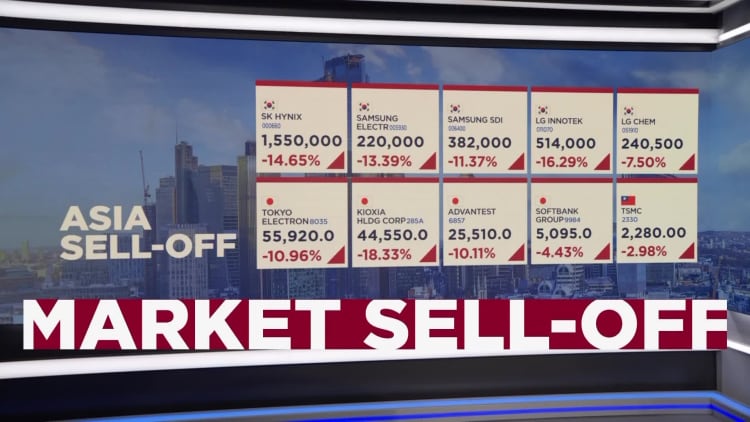
In South Korea, SK Hynix plunged 14.65% at the close, while Samsung Electronics fell more than 13%.
Tech-heavy Nasdaq futures also fell further than the broader index in early morning trade, down 0.73% while the S&P 500 hovered just below the flatline.
— Joseph Wilkins
Semiconductor sell-off sees Kospi temporarily halted
Philips slumps 9% after order intake declines, tariff-boosted earnings
Dutch health tech giant Philips sank 9.6% in early European trading after it reported weaker orders in the second quarter.
Philips said Tuesday that order intakes declined 1% due to the timing of certain large orders, while group sales grew 4.4% to 4.4 billion euros ($5 billion.) It also saw operating income of 609 million euros, which was bolstered by a 186 million euro tariff refund.
Philips’ CEO Roy Jacobs told CNBC’s “Squawk Box Europe” on Tuesday that there was some “lumpiness” and “volatility” in order intakes after six consecutive quarters of very strong order growth.
“If you look underneath that…is that we had some orders slipping in North America, big orders, and falling into Q3,” Jacobs told CNBC’s Steve Sedgewick and Ben Boulos, adding that it expects to see orders pick up in the third-quarter and a second half that is strong on orders.
Adjusted EBITA grew 16.4%, of which 4.2% was from the tariff refund. The company noted that adjusted EBITA actually slightly decreased when excluding the tariff refund, due to cost inflation and higher tariffs.
“We don’t count ourselves rich on tariffs,” Jacobs said, saying it was one of the first companies to apply for a tariff refund. “When they [U.S.] came back with the new tariff round, yes, it’s something that we are against because this hits patient care innovation, and we don’t believe this is very helpful. At the same time, it is a business reality we have to deal with.”
Philips said that its cost-cutting and productivity initiatives drove 132 million euros of savings in the quarter, and it is on track to deliver 1.5 billion in savings in its 2026 to 2028 program.
Meanwhile, the company said free cash flow for the rest of the year is 1.5 to 1.7 billion euros, up from 1.3 to 1.5 billion euros previously due to the tariff refund.
— Sawdah Bhaimiya
Barclays shares slide 4.8%
Barclays shares were down 4.8% in morning trade after the U.K. bank reported a 16% year-on-year jump in group-wide income to £8.3 billion ($11 billion) in the second quarter.
Pre-tax profits for the three-month period to June 30 came in at £3.25 billion.
Its investment bank business saw income jump 20% to £3.96 billion, beating analyst forecasts of £3.7 billion, driven by global markets and investment banking fees.
—Hugh Leask
LVMH lifts luxury stocks as U.S. demand boosts earnings
Shares of LVMH rose as much as 3% after the luxury conglomerate posted second-quarter sales growth at its all-important fashion and leather division for the first time in two years.
The owner of Louis Vuitton, Moët & Hennessy, Dior and Tiffany reported revenue of 19.5 billion euros ($22.2 billion) and organic sales that increased by 3%, largely in line with FactSet estimates.
Results were driven by its watches and jewelry division, which grew 11% in the quarter ended June, and strong U.S. demand, even as sales were dampened by the conflict in the Middle East, which weighed on sales in the region and tourist flows to Europe.
It comes as luxury is seen as cautiously recovering after years of declining growth following a pandemic boom in demand and prices.
Berstein analyst Luca Solca called it “a very gentle and slight inflection point.”
“This is a first positive in fashion and other goods… in two years,” he told CNBC’s “Europe Early Edition” on Tuesday. “That is very good in its own right. It’s very far from what we have seen fashion and leather goods growing in the past, and so I think we are neither here nor there.”
Shares of rivals Hermes and Kering, which are both set to report earnings later this week, rose about 2% each.
– Elsa Ohlen
Man Group’s shares soar 8% after assets swell to record high
Man Group soared to the top of the Stoxx 600 in early trade, after the global hedge fund and alternative investments giant reported an 11% rise in assets under management to a record $253.6 billion in the first half.
The firm reported investment returns of $19.8 billion in the period, with group-wide net inflows of $7.1 billion, 3.4% ahead of the industry average. Net tangible assets reached $758 million as of June 30, up from $723 million on Dec. 31.
Man Group’s London-listed shares were up 8.5% shortly after 8:15 a.m. in London (3:15 a.m. E.T.).
—Hugh Leask
Mainland China stocks close lower, Hong Kong shares rise
Hong Kong’s Hang Seng index was up 0.31% in its last hour of trade Tuesday, while mainland China’s CSI 300 closed 2.83% lower at 4,569.52.
The gains in the Hang Seng were led by utilities and consumer non-cyclicals sectors, up 0.58% and 1.95%, respectively.
Mainland China’s CSI 300 was dragged by tech and basic materials sectors, down 6.28% and1.30%, respectively.
—Justina Lee
‘We are living in an energy demand decade,’ says Baker Hughes CEO
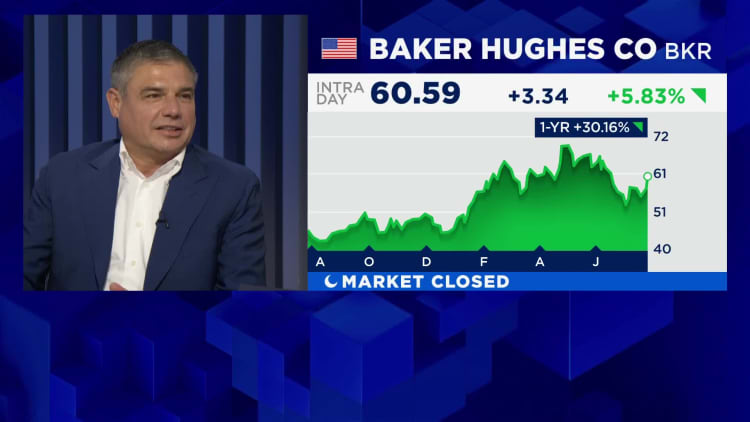
Baker Hughes CEO Lorenzo Simonelli joined CNBC’s Steve Sedgwick and Ben Boulos on CNBC’s Squawk Box Europe this morning to discuss the firm’s latest quarterly results and the wider energy environment.
— Joseph Wilkins
European stocks edge higher; tech stocks flat after Asia chip selloff
European stocks opened in broadly positive territory on Tuesday amid a slew of earnings updates, as oil prices fell and a tech-led sell-off in Asian trading failed to spread.
Shortly after the opening bell, the pan-European Stoxx 600 index was seen 0.2% higher, with all regional bourses and most sectors, except for oil and gas stocks, trading in the green.
London’s FTSE 100 opened 0.1% higher, while France’s CAC 40 added 0.4% and Germany’s DAX added 0.5%.
Tech stocks opened broadly flat, with the semiconductor sell-off seen in Asia not yet spreading to Europe.
— Joseph Wilkins
South Korea’s Kospi closes 11% lower; Japan’s Nikkei falls 4%
Japan’s Nikkei 225 closed 3.95% lower at 62,364.92, while South Korea’s Kospi fell 10.84% to 6,023.66.
Both indexes were supported by losses in tech stocks. Kospi heavyweights Samsung and SK Hynix dropped 13.4% and over 14.7%, respectively. Over in Japan, SoftBank declined 4.43%, and Advantest fell over 10%.
Australia’s benchmark S&P/ASX 200 rose 0.60% to 8,947.80.
—Justina Lee
Mercedes-Benz cuts guidance, battles ‘subdued’ China market
Mercedes-Benz lowered its full-year guidance on Tuesday, after the German carmaker’s sales were held back by “intense competition and subdued consumer sentiment” in its Chinese market.
Total car sales were down 8% year-on-year, but sales in China were 30% lower than in the second quarter last year, underscoring the current difficulties of Western automakers in Asia.
Chief Executive Ola Källenius said in a statement that in the second half of 2026, the group will focus on releasing more new models and improving its “cost position and productivity”.
— Joseph Wilkins
Treasury yields edge lower as investors await Fed meeting
U.S. Treasury yields were lower in Asia trading on Tuesday as investors await the Federal Reserve meeting.
The 10-year Treasury yield was trading 1 basis point lower at 4.628%, as was the 2-year yield down 1 basis point to 4.306%. The 30-year Treasury yield was flat at 5.121%.
“Treasury futures trading volumes remained below average as investors awaited Wednesday’s Federal Reserve interest rate decision,” UOB said in a note on Tuesday.
—Justina Lee
SK Hynix shares tank 11% in Seoul as Asian chip names track losses in U.S. peers
Semiconductor shares in Asia tumbled Tuesday, extending a rout in chipmakers after another weak session on Wall Street.
SK Hynix plunged more than 11%, while Samsung Electronics fell over 9%. Other AI-linked names also saw heavy selling, with Samsung SDI dropping over 8% and Seoul Semiconductor dropping about 7%.
Japan’s semiconductor sector also traded lower. Tokyo Electron dropped more than 10%, Advantest slid 10.25%, while SoftBank Group, a major AI investment proxy through its stake in Arm, declined 6%. Shares of Japan computer memory manufacturer Kioxia plunged more than 17%. Taiwan’s TSMC was down over 2%.
The sell-off followed another weak session for U.S. semiconductor stocks on Monday. The VanEck Semiconductor ETF (SMH) lost more than 2%, adding to its Friday losses. AMD and Teradyne dropped 5% and 4%, respectively. Micron Technology shed about 2%.
— Lee Ying Shan
Hanwha Ocean shares fall 8% as Nomura flags valuation concerns, cuts price target
Shares of Hanwha Ocean fell over 8%, before the Korean Exchange halted trading on the Kospi index.
While the company’s operating profit in the second quarter beat expectations, its valuation remains a concern, Nomura said in note Monday. The brokerage had forecast shares to drop further despite a more than 40% decline from its Feb. 20 peak, attributing it to weak price forecasts for the second half of fiscal year 2026.
Nomura cuts its target price to 63,000 won from 75,000 won and maintained its “reduce” rating.
Hanwha Ocean posted a record first-half operating profit Monday, above 1 trillion won for the first time, driven by a revenue increase from higher-priced vessels and deliveries of offshore projects.
—Justina Lee
Mainland China stocks fall over 1%, Hong Kong shares rise 0.3%
Mainland China stocks fell 1.7% early Tuesday, tracking broad declines in other Asian markets.
Hong Kong’s Hang Seng index bucked the trend to rise 0.33%, supported by technology and industrial stocks.
—Justina Lee
Korea Exchange activates circuit breaker on Kospi, halting trading as stocks tank
The Korea Exchange has triggered circuit breakers on the Kospi, with trading halted for 20 mins after the index plunged 8%.
That followed the exchange’s sell-side sidecar on the Kospi earlier Tuesday, temporarily halting program trading for 5 minutes.
—Justina Lee
Korea Exchange halts trading briefly as stocks tank
The Korea Exchange activated a sell-side sidecar on the Kospi, temporarily halting program trading, as South Korean stocks plunged.
A sell-side sidecar is triggered when the Kospi 200 futures index falls 5% or more for at least one minute, stopping trading for 5 minutes.
—Justina Lee
South Korea’s Kospi leads losses, down nearly 6%, as Asia markets open lower
Asia-Pacific markets opened lower Tuesday, with South Korea’s Kospi leading losses.
The Kospi dropped 5.93% at open, while the small-cap Kosdaq lost 3.63%. Japan’s Nikkei 225 slipped 0.65% and the Topix declined 0.63%.
Australia’s benchmark S&P/ASX 200 was 0.38% lower.
—Justina Lee
Nikkei 225 futures are lower after index rose in prior session
Japan’s Nikkei 225 was poised to decline, with its Chicago futures at 63,920 and the Osaka contract last trading at 63,910, compared with the index’s previous close of 64,931.19.
Hong Kong Hang Seng index futures were at 25,299, compared with the index’s last close of 25,207.18.
In Australia, S&P/ASX 200 futures last traded at 8,821, while the index closed at 8,894.
Hostilities between the U.S. and Iran are on hold, as diplomats seek to give peace talks “some space.” Focus will also be on President Donald Trump‘s meeting with Israeli Prime Minister Benjamin Netanyahu. The two leaders will mainly discuss about Iran. “Our goal is clear: to safeguard Israel’s security, strengthen its power, and expand the circle of peace around us,” Netanyahu said in an X post Monday morning.
—Justina Lee
Tom Lee says the Fed is more likely to shrink the balance sheet
The Federal Reserve is more likely to use quantitative tightening to combat inflation than implement a rate change, according to Tom Lee.
“I think in some ways they might just shrink the balance sheet instead of doing a policy rate change,” the Fundstrat Global Advisors’ head of research told CNBC’s “Power Lunch” on Monday. “What they might say is like, ‘hey, let’s try to put some pressure on growth, but not to deliberately slow the economy.'”
“The stock market’s going to ultimately see the idea that, ‘hey, the Fed shrinks the balance sheet, and then that means they can cut rates.’ And so, then they’ll see the rate cuts as actually positive,” he added. “So, I think it’s going to pave the way for future rate cuts.”
— Sarah Min
Piper Sandler initiates Williams-Sonoma with an overweight rating
Piper Sandler sees a lot to like in Williams-Sonoma, initiating coverage of the stock with an overweight rating on Monday. Its $253 price target suggests almost 12% upside from Friday’s close.
“The company carries a best-in-class EBIT margin while showing steady outperformance in [a] fairly depressed home furnishing industry backdrop,” analyst Peter Keith said in a note to clients. “Over the next 2-3 years we see an opportunity for sales growth acceleration (to HSD%) which should result in EPS growth acceleration to the mid-teens.”
— Michelle Fox
Stocks making the biggest moves after hours
Check out the companies making headlines after hours.
Cadence Design Systems — Shares of the chip design company popped more than 4% after Cadence Design posted second quarter earnings of $2.11 per share, excluding items, topping the LSEG consensus estimate of $2.05 per share. Revenue of $1.58 billion came in line with expectations.
Rambus — The maker of memory interface chips rose slightly after posting second quarter earnings of 77 cents per share, on an adjusted basis, on revenues of $207 million, exceeding estimates. Analysts surveyed by LSEG had expected earnings of 72 cents per share on revenues of $198 million.
Universal Health Services — The hospital and healthcare services provider dropped more than 4% after it lowered its full-year guidance. The company expects earnings in the range of $22.28 to $23.65 per share, on an adjusted basis, down from prior guidance of $22.64 to $24.52 per share, for the year ending December.
— Sarah Min