
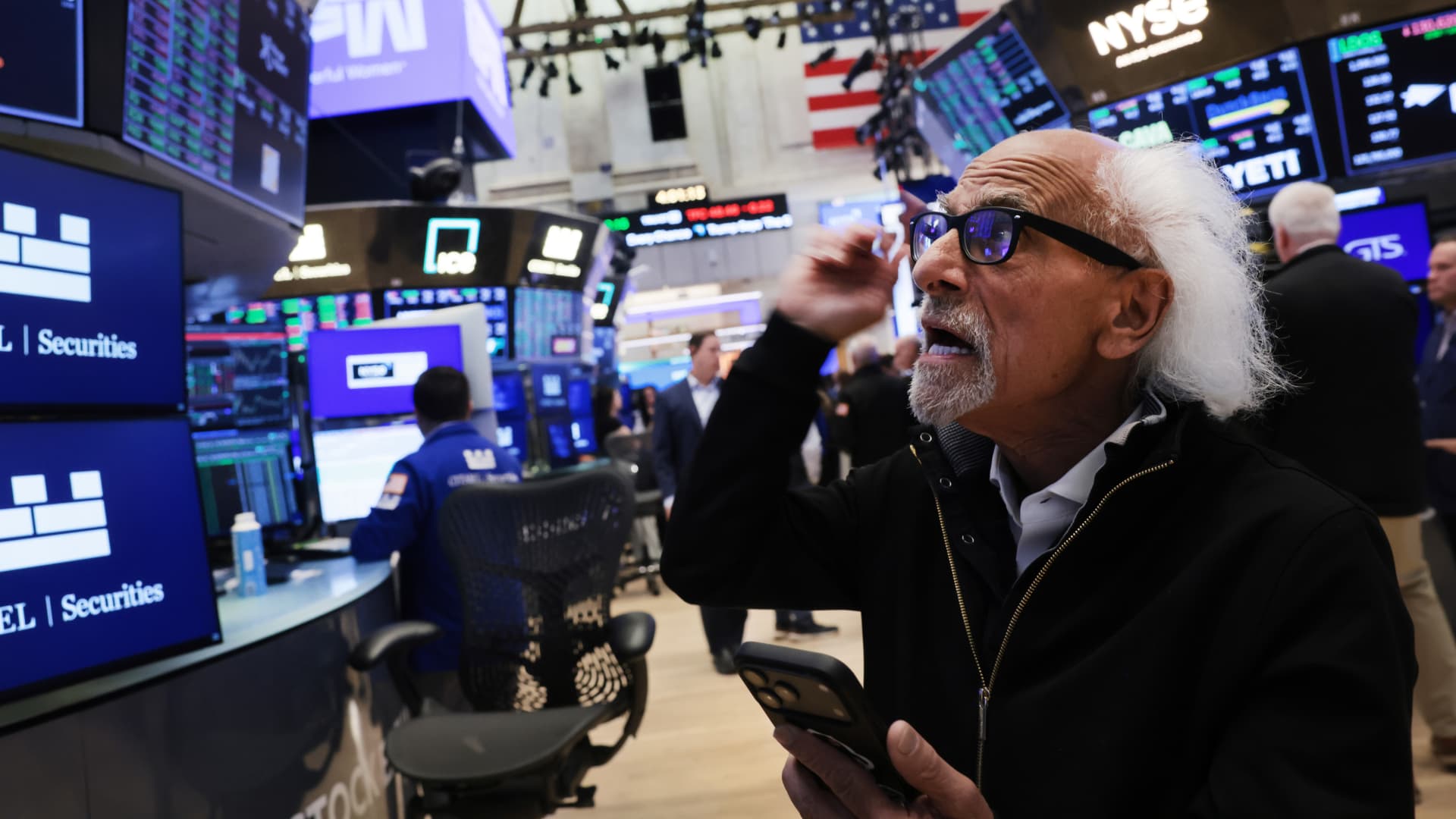
S&P 500 futures declined early Thursday, weighed in part by a rebound in oil prices, as traders looked ahead to the release of a key inflation reading.
Futures linked to the broad market index were 0.2% lower, while Nasdaq 100 futures lost about 0.3%. Futures tied to the Dow Jones Industrial Average slipped 62 points.
West Texas Intermediate crude oil futures rose 1.8% to top $90 a barrel. The action came after Reuters reported, citing a U.S. official, that the U.S. military conducted new strikes in Iran, targeting a military site. Brent futures were also up nearly 2% at $96.07.
Shares of Snowflake soared 36% in Wednesday’s extended trading session after the cloud-based data platform provider inked a plan to spend $6 billion on Amazon Web Services over five years. The company also reported a first-quarter earnings and revenue beat.
The moves came after a decline in oil prices pushed the blue-chip Dow to a new intraday and closing record on Wednesday. Crude oil prices fell in Wednesday’s session after Secretary of State Marco Rubio said during a White House Cabinet meeting that talks with Iran have made some progress, adding that the administration prefers “the negotiated diplomatic route and we’re going to give it every chance to succeed.” However, President Donald Trump said that he will not allow Iran to control the key Strait of Hormuz as part of a deal.
These comments came after Iranian state television had earlier said that Tehran is committed to restoring commercial traffic through the Strait of Hormuz back to prewar levels within one month of an agreement with the U.S., Reuters reported. The White House denied the report about a memorandum of understanding as “a complete fabrication.”
Investors are awaiting the release of April’s personal consumption expenditure price index reading, due out at 8:30 a.m. ET on Thursday. The index, which is the Federal Reserve’s preferred gauge of inflation, is especially important now that Kevin Warsh has taken the helm as Fed chair.
Economists polled by Dow Jones expect a month-over-month increase of 0.5% and year-over-year rise of 3.8%. Excluding volatile food and energy prices, they anticipate gains of 0.3% and 3.3%, respectively.
Middle East tensions rattle Asia markets after fresh U.S. strikes in Iran
Asia-Pacific markets closed lower Thursday as tensions in the Middle East escalated after fresh U.S. strikes in Iran overnight.
West Texas Intermediate futures for July were 2.22% higher at $90.65 per barrel as of 5:38 a.m. ET. Brent crude futures for July rose 2.12% to $96.29 per barrel.
South Korea’s Kospi ended Thursday’s session at 0.53% lower at 8,185.29, while the small-cap Kosdaq dropped 2.54% to 1,104.36.
Japan’s Nikkei 225 fell 0.47% at 64,693.12, while the Topix declined 0.41% at 3,902.01. Australia’s S&P/ASX 200 was 1.43% lower at 8,592.90.
China’s CSI 300 gave up early losses to gain 0.12% at 4,914.21, while Hong Kong’s Hang Seng dropped 1.27%.
India’s Nifty 50 was flat, while the BSE Sensex was down 0.19%.
— Justina Lee, Lee Ying Shan
European stocks fall
European shares were broadly lower on Thursday morning, as investors continued to monitor developments in the U.S.-Iran war.
By 4:45 a.m. ET, the pan-European Stoxx 600 was 0.5% lower, with most sectors and major bourses in negative territory.
— Chloe Taylor
Nio shares jump after the Chinese EV maker launches its new ES9 SUV
Shares of Chinese electric carmaker Nio jumped as much as 10.45% in Hong Kong trading on Thursday after the company officially launched its ES9 SUV a day earlier.
Its U.S.-listed stock closed 9.32% higher overnight, extending gains for 2026.
Nio said the ES9 SUV would start at 390,000 yuan ($57,470) under its battery subscription model, which separates the cost of the vehicle from battery payments made monthly.
The pricing underscores intensifying competition in China’s electric vehicle market, despite Beijing’s attempts to rein in excessive price wars, commonly referred to in China as involution.
Nio delivered 83,465 cars in the first quarter, nearly twice as many as a year ago, but a 33% drop from the fourth quarter.
Read the full story here.
— Evelyn Cheng
LG Energy Solution’s shares surge as much as 16% after landing major U.S. battery storage deal
Shares of LG Energy Solution surged as much as 16.56% Thursday after its U.S. unit secured a deal to supply battery cells for DTE Energy‘s storage projects in Michigan.
The eight projects will deliver 1.5 gigawatts of battery storage, or 6 gigawatt-hours, allowing electricity to be stored when excess power is generated and distributed to customers as needed, the company’s unit, LG Energy Solution Vertech, said in a press release.
The deal is worth $1.6 billion, according to a Yonhap report.
Read the full story here.
—Justina Lee
Asia markets open lower amid mixed signals from Iran-U.S. negotiations
Asia-Pacific markets opened lower Thursday as investors continue to assess mixed signals from the ongoing Iran-U.S. negotiations amid a fragile ceasefire.
South Korea’s Kospi dipped 0.36%, while the small-cap Kosdaq extended early losses, falling 2.61%.
Japan’s Nikkei 225 was marginally lower, while the Topix declined 0.23%. Australia’s S&P/ASX 200 was 0.79% lower.
China’s CSI 300 slipped 0.38%, while Hong Kong’s Hang Seng dropped 0.69%.
—Justina Lee
Fed’s Kashkari said lowering inflation remains his top priority
Minneapolis Federal Reserve President Neel Kashkari said that lowering inflation in the U.S. is still his top priority.
“I am focusing heavily on inflation. I’m not ignoring at all the labor market,” he told CNBC’s Kaori Enjoji at the Bank of Japan-IMES conference overnight Wednesday. “We need to pay attention to both sides, but the labor market is in decent shape right now, while inflation is simply much too high.”
Kashkari’s comments follow remarks from Fed Governor Lisa Cook, who said on Wednesday that inflation is “clearly moving in the wrong direction.”
After five years of above-target inflation, I am particularly attuned to the risk that elevated inflation will become embedded in price- and wage-setting behavior,” she said in prepared remarks for a speaking engagement at Stanford Institute for Economic Policy Research.
“As such, I am prepared to raise rates, if the expected disinflation does not appear in a timely manner,” she said.
The Fed officials comments arrive ahead of a key inflation indicator due Thursday morning, the personal consumption expenditures price index.
Read more here on Kashkari’s comments from CNBC’s Lim Hui Jie.
—Darla Mercado
Stocks making the biggest moves after the bell: Snowflake, Marvell Technology and more
These are the stocks moving the most in extended-hours trading:
- Snowflake — The cloud-based data platform soared 37% in extended trading. Snowflake has inked a plan to spend $6 billion on Amazon Web Services over five years.
- Marvell Technology — The semiconductor company slipped more than 1% even after posting a rosy outlook for the current quarter.
- Agilent Technologies — Shares popped almost 8% after the healthcare equipment provider raised its full-year adjusted earnings guidance to between $6 and $6.10 per share, higher than previous estimates of between $5.90 to $6.04 a share.
Read the full list of stocks moving here.
— Lisa Kailai Han
FedEx spin-off FedEx Freight to join S&P 500 on June 2
FedEx spin-off FedEx Freight is set to replace EPAM Systems in the S&P 500, effective prior to the opening of trading on Tuesday, June 2. EPAM Systems will then replace Shutterstock in the S&P SmallCap 600 on the same day.
FedEx is spinning FedEx Freight off in a transaction expected to be completed June 1. FedEx Freight will also replace American Airlines Group in the Dow Jones Transportation Average effective prior to the open of trading on Monday, June 1.
FedEx Freight is slated to start trading Monday on the New York Stock Exchange under the ticker “FDXF.”
Meanwhile, Dave will replace American Woodmark in the S&P SmallCap 600 effective prior to the opening of trading on Monday, June 1. MasterBrand is acquiring American Woodmark in a deal expected to close on May 29.
— Lisa Kailai Han
There’s no beef with Burger King’s happy meal
Wolfe Research analysts found Burger King’s Mandalorian kids meal is catching momentum and helping the company’s performance. The meal launched on April 28, nearly a month ahead of the Star Wars franchise release date.
“We view this as an incremental tailwind for Burger King within the family occasion, which carries a higher average ticket than other dayparts,” the analysts wrote in their Wednesday report.
Wolfe analysts also said that higher gas prices may be weighing on lower income consumers and affecting the cohort’s performance at restaurants.
“We suspect higher gas prices may be the real culprit — with prime tax refund season now behind us, the prolonged impact of elevated gas prices appears to be further stretching an already pressured consumer base,” the report said.
— Ananya Chetia