
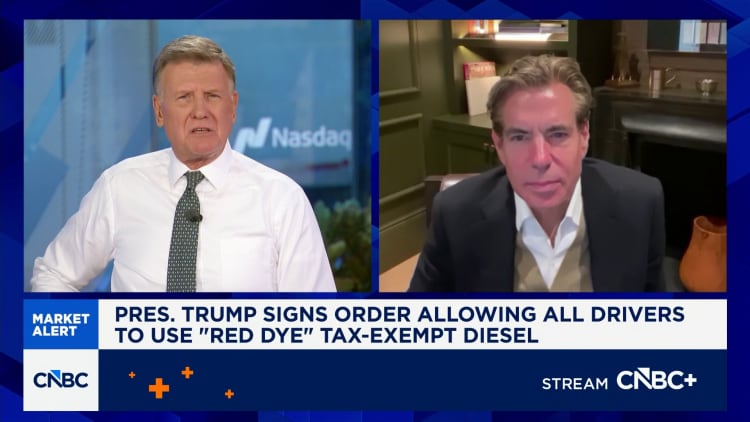
- President Donald Trump’s order allowing highway truckers to use off-road diesel only defers federal excise taxes. Truckers may still have to pay later.
- Trump’s order does not defer state excise taxes, which can be higher.
- The latest move comes after the president abandoned the idea of banning diesel exports.
- Analysts say the only real solution to high fuel prices is an end to the war in the Middle East.
Truckers won’t see much in the way of relief from President Donald Trump’s executive order that allows them to use off-road diesel fuel on America’s highways without federal penalties.
Off-road diesel is exempt from federal and state excise taxes because it is used for construction and farm equipment, railways and to heat homes. It is dyed red to differentiate it from taxed on-road diesel, but is otherwise the same fuel.
The federal government charges an excise tax of 24.4 cents per gallon for on-road diesel. In theory, Trump’s order spares truckers the tax by allowing them to use red-dyed fuel on the highway, without worrying that the federal government will impose penalties for avoiding taxes.
But the president’s action only defers the actual tax payment itself until the end of the year, while calling on the Treasury Secretary to look for ways to eliminate the deferred obligation altogether.
“While it might be deferred, it may not disappear entirely,” said Any Lipow, president of Lipow Oil Associates. “Maybe you save a little bit of money up front, but you might have to pay it to the government later.”
Trump cannot defer state excise taxes, which can be higher than the federal obligation, at a national average of 35.5 cents per gallon. Some states have taken independent action to give relief to diesel users.
Although Trump is waiving federal penalties for using off-road diesel on highways, states in principle could enforce their local laws prohibiting the red-dyed fuel on the road.
“It’s not like every state trooper is going to pull over the truck and look at your diesel fuel, but you’re a trucker — do you need that aggravation?” Lipow said.
‘No good options’
Trump’s executive order comes as he faces political pressure to take action on diesel prices ahead of midterm elections on Nov. 3, when Republicans face competitive races in farm states such as Iowa. Retail diesel prices hit a record high in September and currently average $6.30 a gallon nationally, according to AAA.
The president flirted with a diesel export ban last month but ultimately abandoned the idea, telling reporters Friday that “it was never really on the table.” The oil industry and big business groups were staunchly opposed. Trump publicly voiced concerns that a diesel export ban would raise gasoline prices.
Diesel futures dropped overnight Monday into Tuesday morning after Trump’s executive order, but ultimately turned higher. Futures were up more than 1% Wednesday.
“What it shows you is there are no good options for the administration or any administration to bring down the price of fuel, because the bottleneck is refineries,” Lipow said.
Diesel prices are high around the world because Ukraine is bombarding Russian refineries and strikes by Iran and its allies have taken capacity offline in the Middle East.
G7 countries led by France, facing pressure from the Trump administration, agreed Friday to release diesel stocks, though it’s unclear in what quantities.
“They’re pulling every every lever they can,” Jeff Currie, CEO of Real Macro and a senior advisor at Carlyle, told CNBC’s “Squawk Box” on Tuesday.
But Trump’s executive order allowing red-dyed diesel on the road “won’t have a profound impact” on fuel prices, Currie said.
There is one action the administration could take that would be effective, Lipow said. “End the conflict.”
“The Strait [of Hormuz] reopens, oil flows, those refineries in the Middle East start kicking up runs, more refined products make it to the market,” the analyst said. “The market will react to that.”