

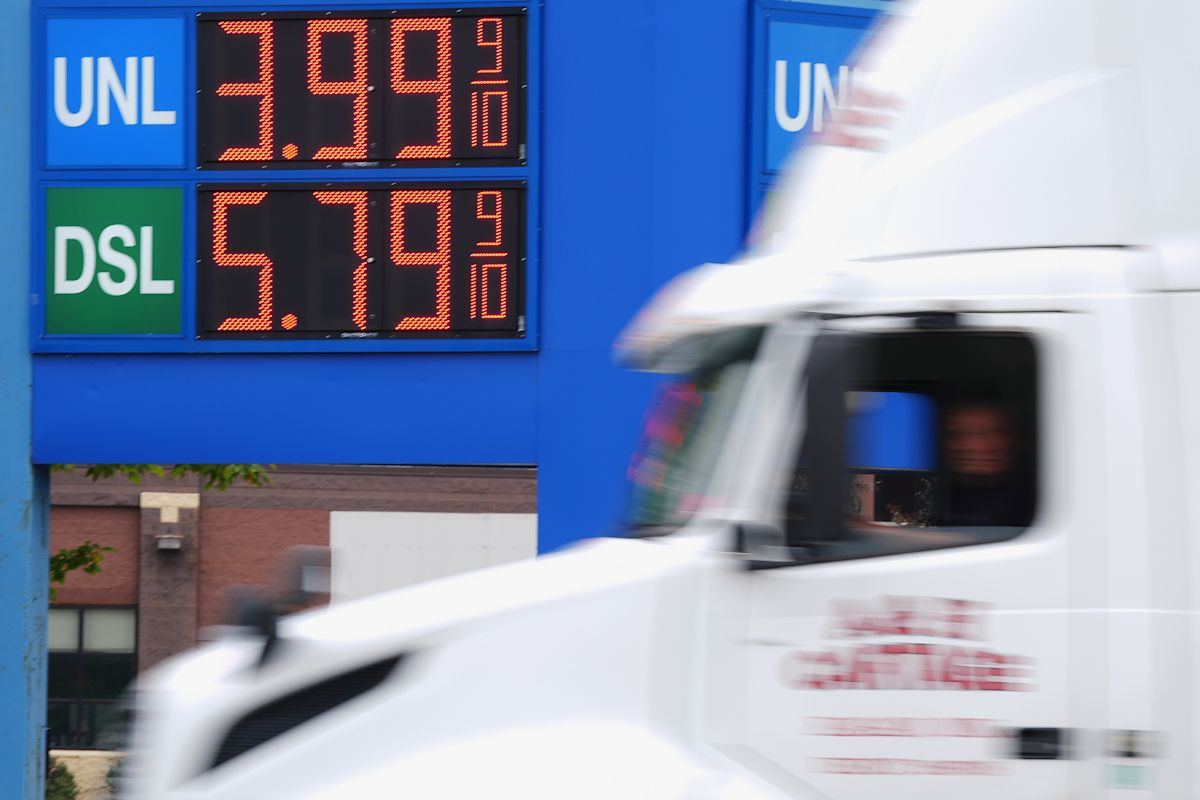
The national average price for a gallon of gasoline hit $4.14 heading into Labor Day weekend, according to AAA, the highest ever recorded for the holiday and the first time the average has been above $4 on Labor Day. The price broke a record set 14 years ago, when the average was $3.82 on Sept. 3, 2012. A year ago, Americans were paying just $3.19.
On CNN’s “State of the Union” on Sunday, host Dana Bash pointed out to Energy Secretary Chris Wright that he had said on the same show in April that gas prices had peaked and might not fall below $3 per gallon until 2027. She asked whether — with the war in Iran, the Russia-Ukraine war and dwindling U.S. reserves — prices could go higher.
“I don’t want to have an opinion on that,” Wright said.
Advertisement
Advertisement
He then pointed to the gasoline futures market, which he said was pricing the fuel about 30 cents a gallon lower two months out. He said the Trump administration had changed blending requirements to allow American refiners to produce more gasoline, and named several Democratic-led states that have declined to adopt the new standards.
“New York, Connecticut, California and several other Democrat-governed states have decided not to adopt those standards,” Wright said. “They apparently want to keep driving up prices on their residents.”
Bash pressed. “Respectfully, as the energy secretary, shouldn’t you have an opinion on where gas prices are and where they’re going?”
“Gasoline production is about to go up and demand is about to go down,” Wright said. “So if I had to guess, they’re more likely to go down than go up.”
Diesel is also at a record. Wright won’t say when it comes down.
Bash turned to diesel, which hit a record $5.85 per gallon on Friday, surpassing the previous record set in June 2022 shortly after Russia invaded Ukraine. She noted the fuel powers farm equipment, trains and trucks that move produce and other goods to stores.
Advertisement
Advertisement
Wright named several forces at once. He called Ukrainian strikes on Russian refineries the biggest single factor, and said Russia has since banned diesel exports and China has throttled back its own. He said the Biden administration closed more than a dozen U.S. refineries. He also singled out California Gov. Gavin Newsom, who Wright said had closed two significant refineries in the past 12 months. (According to the Energy Information Administration, 11 refineries have left U.S. crude processing since 2020, spanning both the Trump and Biden administrations. Some converted to renewable diesel rather than closing entirely.)
“Democratic policies for the last 15 years to crimp the production of hydrocarbons in the United States is certainly taking a toll,” Wright said. “But we’re rowing in the other direction.”
Part of that fix, Wright said, would come from Venezuela, where he said the Trump administration was working to expand oil production and eventually refinery capacity. He said Venezuelan oil production was up 25 percent and its exports up 50 percent.
Bash pushed back. The Venezuela deal, she said, “doesn’t sound like that’s going to make production up and running for like 10 years or so.” She asked whether Americans would just have to wait for diesel prices to come down.
Advertisement
Advertisement
“We have lots of actions to push in the other direction, so we’ll see,” Wright said.
The politics
The interview lands as the cost of living dominates the run-up to the 2026 midterm elections, now two months away. President Trump’s approval on inflation is at 24.4% approve to 70.5% disapprove — a 46-point gap that’s larger than the worst stretch of President Joe Biden’s presidency during the pandemic-era price spikes.