

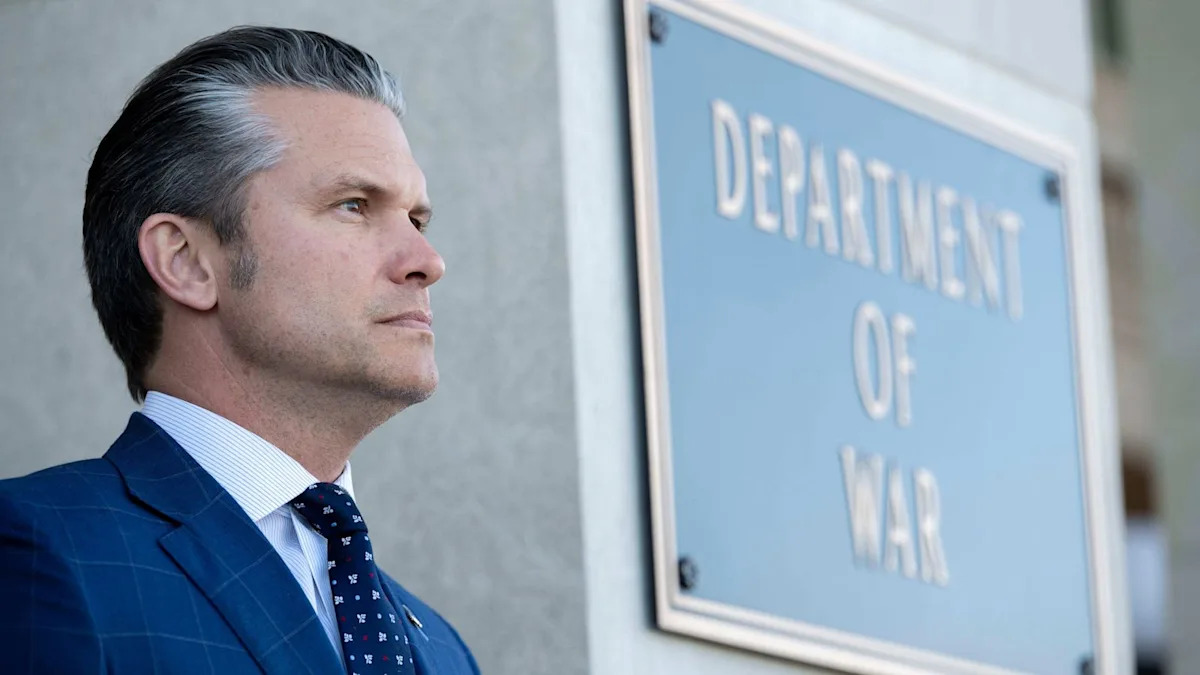
The Pentagon has released a priority-shifting National Defense Strategy, capping off a week of animosity between the Trump administration of traditional allies like Europe.
“For too long, the US Government neglected — even rejected — putting Americans and their concrete interests first,” read the opening sentence.
Coming in the wake of US President Donald Trump threatening to impose tariffs on some European partners in his bid to acquire Greenland, and falsely claiming that Nato forces “stayed a little back” from the frontline in Afghanistan, the document will do little to lower the temperature.
Advertisement
Advertisement
As allies confront what some see as a hostile attitude from the US, they will almost certainly be unhappy to see that Defense Secretary Pete Hegseth’s department will provide “credible options to guarantee US military and commercial access to key terrain”, especially Greenland and the Panama Canal.
It chastises US allies to take control of their own security and reasserts focus on dominance in the Western Hemisphere, above a longtime goal of countering China.
The 34-page document, the first since 2022, was highly political for a military blueprint, criticising partners from Europe to Asia for relying on previous US administrations to subsidise their defense.
It called for “a sharp shift — in approach, focus, and tone”.
Advertisement
Advertisement
That translated to a blunt assessment that allies would take on more of the burden countering nations from Russia to North Korea.
Much like the White House’s National Security Strategy that preceded it, the defense blueprint reinforces Trump’s “America First” philosophy, which favors nonintervention overseas, questions decades of strategic relationships and prioritises US interests.
The National Defense Strategy last was published in 2022 under then-President Joe Biden and focused on China as America’s “pacing challenge.”
From one crisis to another: A week in Trump-land that feels like an epoch
Trump threatens tariffs against countries who oppose his Greenland plans
Western Hemisphere
The strategy simultaneously courts help from partners in America’s backyard, while warning them that the US will “actively and fearlessly defend America’s interests throughout the Western Hemisphere.”
Advertisement
Advertisement
It specifically points to access to the Panama Canal and Greenland.
It comes just days after Trump said he reached a “framework of a future deal” on Arctic security with NATO leader Mark Rutte that would offer the U.S. “total access” to Greenland, a territory of NATO ally Denmark.
China and the greater Asia-Pacific region
The new policy document views China — which the Biden administration saw as a top adversary — as a settled force in the Indo-Pacific region that only needs to be deterred from dominating the US or its allies.
The goal “is not to dominate China; nor is it to strangle or humiliate them,” the document says. It later adds, “This does not require regime change or some other existential struggle.”
Advertisement
Advertisement
“President Trump seeks a stable peace, fair trade, and respectful relations with China,” it says, which follows efforts to climb down from a trade war sparked by the administration’s sky-high tariffs. It says it will “open a wider range of military-to-military communications” with China’s army.
Subscribe free to our weekly newsletter for exclusive and original coverage from ITV News. Direct to your inbox every Friday morning.
The strategy, meanwhile, makes no mention of or guarantee to Taiwan, the self-governing island that Beijing claims as its own and says it will take by force if necessary. The U.S. is obligated by its own laws to give military support to Taiwan.
By contrast, the Biden administration’s 2022 strategy said the U.S. would “support Taiwan’s asymmetric self-defense.”
Advertisement
Advertisement
In another example of offloading regional security to allies, the document says, “South Korea is capable of taking primary responsibility for deterring North Korea with critical but more limited U.S. support.”
Europe
While saying that “Russia will remain a persistent but manageable threat to NATO’s eastern members for the foreseeable future,” the defense strategy asserts that NATO allies are much more powerful and so are “strongly positioned to take primary responsibility for Europe’s conventional defense”.
It says the Pentagon will play a key role in NATO “even as we calibrate US force posture and activities in the European theater” to focus on priorities closer to home.
Advertisement
Advertisement
The US already has confirmed that it will reduce its troop presence on NATO’s borders with Ukraine, with allies expressing concern that the Trump administration might drastically cut their numbers and leave a security vacuum as European countries confront an increasingly aggressive Russia.
Want a quick and expert briefing on the biggest news stories? Listen to our latest podcasts to find out What You Need To Know…