

- On Saturday, the Panama-flagged tanker Centuries was seized by the U.S., an action that may have required cooperation from Panama’s government.
- China, a major buyer of crude oil from the region, condemned the U.S. action.
- Any cooperation from Panama over tanker actions comes amid an already complex relationship between the Central American nation and the U.S. and China, as they battle over control of the Panama Canal.
The escalating U.S. campaign to seize oil tankers linked to Venezuelan oil could also escalate tensions between the U.S. government and China if more crude oil intended for the Chinese market is caught up in the U.S. military campaign.
On Saturday, the Panama-flagged tanker Centuries was seized carrying sanctioned Venezuelan oil, a move condemned by China. The seizure was the latest in the President Donald Trump‘s vow to block tankers carrying Venezuelan oil. Maritime experts say the move may have relied on a legal authority that suggests more seizures will be coming, and potentially target more oil intended for the Chinese market.
According to Dimitris Ampatzidis, senior risk and compliance analyst at Kpler, the seizure of the Panama-flagged Centuries may have been conducted under the 2002 Salas-Becker agreement, which allows U.S. authorities to board Panamanian-flagged vessels with just two hours’ notice.
“The most interesting part of the Centuries seizure is the suggestion of the U.S. likely relying on its prior boarding agreement with the Panama Maritime Authority,” said Ampatzidis, adding that the use of this agreement can lead to additional seizures.
Kpler analysis shows that out of the total of 23 shadow tankers currently identified within Venezuela’s exclusive economic zone, three of those vessels are operating under the Panama flag and are loaded with sanctioned Venezuelan crude.
“If the Ragnar, Balsa, and Larko attempt to depart, it places them in the higher-risk enforcement category because they are operating under the Panama flag,” Ampatzidis said. “We can see seizures as we saw with the Centuries.”
Ragnar was loaded on Dec. 16, and Balsa and Larko were loaded on Dec. 17.
“Beyond already-sanctioned vessels, the U.S. appears increasingly willing to target other ships linked to the shadow fleet when they attempt to depart Venezuela with cargo — particularly if they are stateless (no flag) or Panama-flagged,” Ampatzidis said.
“The most interesting aspect of all of this is that by squeezing Venezuelan oil, you are not only putting tremendous pressure on the Maduro regime, but you are also impacting China strategically,” said Aaron Roth, retired Coast Guard captain and principal, federal strategy & security, for the Chertoff Group. “The longer it goes on and it may create negotiating space in U.S.-China diplomacy, because Venezuelan oil is discounted to China, and it’s the type of heavy crude that China can refine,” he said. “Without VZ oil, China will have to go to the market to Russia and the Middle East, which will be more costly to them,” he added.
Venezuela has produced around 900,000 barrels of crude oil and condensate so far in 2025, accounting for roughly 1% of the total global supply. Kpler data indicates China buys about 76% of Venezuela’s output. The U.S. has imported around 17% of Venezuela’s output in 2025. That is about half of the percentage of output imported in 2024. Cuba, Spain and Italy are the other significant customers of Venezuela’s oil.
Both the U.S. Coast Guard and U.S. Department of Transportation referred requests for comment to the White House, which did not respond by press time.
Recent history of the seized Centuries tanker
Kpler data showed Centuries had previously been actively involved in multiple operations linked to the transportation of Venezuelan crude and fuel oil, both as a long-haul tanker loading at Jose Oil Terminal in Venezuela, and as a transshipment vessel operating offshore in Venezuela and Malaysia.
Kpler data showed the U.S. seized Centuries after it loaded crude at Jose Oil Terminal. Kpler data detected spoofed AIS positions concealing the location of the tanker just before the vessel was loaded. The erroneous signals showed the vessel was sailing toward the Caribbean in early December, reached the northern coast of Curaçao on December 12, and remained ostensibly stationary in that area.
However, imagery analysis by Kpler showed that the vessel had in fact been off the coast of Venezuela since at least Dec. 4. Additional supporting imagery indicated the tanker was empty during that period. But on December 9, satellite imagery confirmed the tanker was being loaded at the Venezuelan port JOT’s west pier.
Venezuelan port operation reports reviewed by Kpler showed the vessel operating under the alias “Crag” was loaded with approximately two million barrels of Venezuelan Merey crude from the same berth around the same time Centuries was loading. Following the loading, Centuries remained just east of JOT, with imagery showing the tanker positioned off the coast of Lechería, Venezuela, on Dec. 16.
“Two days later, satellite imagery showed that the vessel had departed Venezuelan waters and was observed approximately three miles south of Grenada, consistent with a voyage toward Asia,” according to a report by Kpler on the Centuries seizure.
The market is not able to know in advance if any vessel filled with sanctioned oil is directly going to China, with the spoofing and transshipment between tankers used to avoid detection, and confirmation only available after the fact. Both vessels seized over the weekend do have a prior history of transporting crude oil to China, according to Kpler.
Centuries was first observed loading two million barrels of sanctioned Venezuelan Merey crude in April 2020. The oil was discharged at Yantai oil terminal in Shandong Province, China.
The second vessel seized over the weekend, Bella 1, was empty and heading to Venezuela. The tanker earlier in the year transported Iranian oil to Qingdao, Shandong Province in mid-March. The last voyage Bella 1 made from Venezuela was in May 2023 and that oil also went to Qingdao and Tianjin, China.
“What still is yet to play out would be a reaction from China should the Trump administration seize a vessel headed their way,” said Andrew Lipow, president of Lipow Oil Associates.
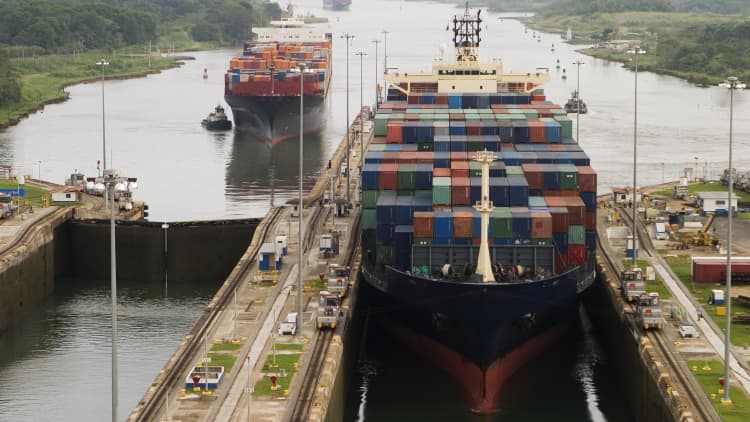
The seizure of Panama-flagged vessels like the Centuries also comes amid existing friction between the U.S., China and Panama over control of the Panama Canal. Trump has threatened to take the Panama Canal back, saying the waterway is being controlled by China.
“Geopolitics, in many different forms, increasingly impacts world trade, economic relations and maritime supply chains. This seems to be another example of that,” said Peter Sand, chief shipping analyst at Xeneta.
United States’ use of a legal agreement requiring the cooperation of Panama to seize vessels could be perceived by China in context of the larger fight over the canal. “If the vessel is truly Panama-flagged and you’re boarding on the high seas, you typically need flag-state authorization (for Centuries that would be Panama),” said Brandon Daniels, CEO of supply chain consulting firm Exiger. “The U.S. and Panama have frameworks that can streamline that consent. It would most likely point to cooperation, via Salas-Becker or another mechanism,” he said.
While China framed the recent U.S. action as an international-law violation, the U.S. is treating the seizure as sanctions evasion, and shadow-fleet tactics meant to defeat enforcement. “With the documented misrepresentations of origin in this case, I lean heavily to the latter,” Daniels said.
But Daniels, who spoke with Panama President José Raúl Mulino earlier this year about the tensions over the Panama Canal, added, “He takes their sovereignty very seriously.”
Hong Kong-based CK Hutchison owns and operates the Balboa and Cristóbal ports which are located on both sides of the canal. The U.S. has accused China of having “influence and control” over the canal, and claims that threat represents a “violation of the treaty” between the U.S. and Panama.
A preliminary agreement for the sale of the two disputed ports at the Panama Canal made earlier this year between CK Hutchison and a consortium led by BlackRock, through its Global Infrastructure Partners unit, and Mediterranean Shipping, has stalled. Beijing has been against the deal. China is reportedly pushing for state-owned ocean carrier Cosco to have a controlling stake in the proposed $22.8 billion deal.
Daniels says the concerns of the Trump administration of Chinese influence will remain if Cosco is added into the agreement. But he described Mulino as also prizing “the trust he has with Asian trading partners.”
“I don’t think the more aggressive Chinese moves on Balboa and Cristobal stop Panama from keeping the canal neutral or cooperating with the U.S.,” Daniels said.
“China may gain a chokepoint in global trade container transshipment capacity, berthing priority, yard operations, and commercial data exhaust with Cosco having control. It does put pressure on the supply chain,” he said. “But the CCP can exert influence over Hong Kong entities today (like the current operations owner CK),” he added.
He said the current situation shows the dynamic, complex relationships Panama has with both China and the U.S. “Panama is very focused on being a South Asian corridor and a major flag state for vessels, but it seeks cooperation with the U.S as a strategic imperative to sustainable funding,” Daniels said.