

Stocks opened lower on Friday as investors remained uneasy following a Big Tech sell-off and as U.S. oil prices topped $100 a barrel amid rising fears that the U.S.-Iran conflict would flare up again.
S&P 500 fell 0.6% and Dow Jones Industrial Average tumbled 521 points, or 1%. Nasdaq pulled back 5%.
Big Tech shares like Microsoft and Meta were trading lower, while chip stocks were rebounding slightly, with Micron Technology and Advanced Micro Devices ticking up more than 1%. On Thursday, many technology stocks pulled back as traders assessed the impact of outsized corporate borrowing and rising rates on artificial intelligence and other tech names.
CoreWeave, which has become the poster child for data center companies using aggressive amounts of borrowed money, dropped 10% on Thursday. Its shares slipped less than 1% on Friday.
Ed Yardeni, president of Yardeni Research, described the AI trade on Thursday as a “bubble” but said that some depressurization wouldn’t be all bad.
“Taking some air out of the AI bubble is a good thing. I don’t think it’s going to burst and create problems for the economy,” he said, pointing to the bond market as a source of capital competition for equities.
The 10-year Treasury yield added 1 basis point to 4.9697% on Friday. The yield on the 30-year was flat and the 2-year yield fell 2 basis points. The upward moves come after Treasury yields fell sharply Thursday as investors looked to U.S. government bonds as a safe haven.
Oil prices also rose on Friday, further pressuring stocks. West Texas Intermediate futures were up 1.4% to $100.90 per barrel. Brent crude prices rose 0.75% to $114. It follows reports that the U.S. and Israel may be drawing up plans for renewed attacks on Iran as part of the regional war that started in late February.
On the week, the S&P 500 is heading for a slim gain, up less than 0.1%, while the Nasdaq is down 0.5% in the period. The Dow is tracking for a 1.7% advance.
Stocks open lower
Volatility index surges above 20 after gaining 14% Thursday
The Cboe Market Volatility Index climbed another 6% Friday, rising to 20.24, after jumping 14% Thursday to 19.03.
For the week, the VIX — widely called Wall Street’s “fear gauge” — is on track to close above 20 for the first time since early June. Last week, the VIX, which measures the market’s expectation of 30-day forward implied volatility based on S&P 500 index options, soared 34.7% to close at 19.99, the largest one-week gain also since early June.

— Scott Schnipper
Stocks make big moves in pre-market trading
Here are the stocks making the biggest moves before the bell.
Moderna – Shares are down 5.7% Friday morning after falling 25% on Thursday following a leak of partial data on its closely watched cancer vaccine developed with Merck. Both stocks faltered even though the full data which was released Thursday appeared meaningful for patients and positive relative to Wall Street expectations.
Deckers – Shares of the shoemaker are down 6.7% after it reported fiscal second quarter earnings late Thursday that missed analyst expectations. Revenue for the quarter ended Sept. 30 was $1.43 billion compared to the $1.51 Wall Street was expecting. Revenue from top brands including HOKA and UGG missing FactSet expectations.
SpaceX — Shares of the Elon Musk space and AI company were also getting a boost from an upgrade on Wall Street. PhillipCapital double upgraded the shares to buy from sell, raising its price target all the way to $250 from $75, citing surprising gains for its AI business. The new price target represents a 70% gain from here.
Bloom Energy – shares are down 2.5% after the energy technology solutions provider for data centers reported third quarter earnings late Thursday. Despite beating on the top and bottom line and raising its full-year 2026 earnings per share guidance, what stirred fear among investors was the reported negative free cash flow for the quarter.
Read the full list.
— Paulina Likos, Liz Napolitano
Telecommunications stocks fall as SpaceX reportedly moves toward becoming wireless carrier
Telecommunications stocks slid on Friday following a report that SpaceX is taking another step toward becoming a wireless carrier.
The Elon Musk-led company is in talks to obtain access to at least 80,000 cell sites across the U.S., Bloomberg reported Thursday, citing people familiar with the matter. SpaceX has discussed its plans with Crown Castle, among other cell infrastructure firms.
AT&T and T-Mobile US fell nearly 5% in pre-market trading, while Verizon Communications pulled back about 4%.
— Liz Napolitano
PhillipCapital hikes SpaceX to buy from sell after earnings
Stronger-than-expected revenue from SpaceX’s AI business is making PhillipCapital — once a bear on the company — bullish about the Elon Musk giant’s stock.
The firm upgraded shares of the space and AI company to buy from sell, and hiked its price target to $250 from $75. That level implies an almost 73% gain from Thursday’s close. Analyst Glenn Thum wrote in a Friday note that the company had key catalysts driving SpaceX into a profit for the first time as a publicly-traded stock, one of them being its AI business.
“SI, as new cloud services agreements came online at higher rental prices and Cursor added US$608mn from mid-August,” Thum said in the note, referring to the company’s AI business as its branded “super intelligence” name. “Operating leverage, as higher-margin cloud services turned SI profitable.”
Shares of SpaceX were higher by 1% in premarket trading Friday. CNBC Pro subscribers can read more here.
— Davis Giangiulio
Treasury yields move higher
Treasury yields edged higher early Friday, following a sharp drop in the previous session.
Yields on 10-year U.S. Treasurys — the main benchmark for mortgages, auto loans and credit card debt — rose by 2 basis points to 4.9759%.
The yield on the 2-year Treasury note, which more closely follows short-term Federal Reserve rate decisions, also increased by 2 basis points to 4.6625%. The yield on longer-dated 30-year U.S. Treasurys — which tends to move on geopolitical developments — was up more than 1 basis point to 5.2985%.
— Hugh Leask
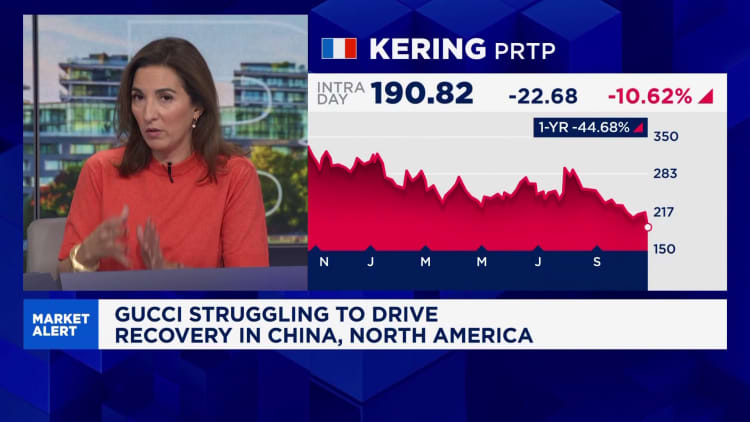
Gucci-parent Kering stock plunges amid luxury slump
Shares of Gucci-owner Kering fell 12% in early trading after the luxury company posted disappointing third-quarter earnings.
The move puts the stock firmly at the bottom of the pan-European blue-chip Stoxx 600 index, and brings 12-month losses to 43%.
Same-store sales declined by 1% overall, driven by a 6% decline for Gucci, its biggest brand and main moneymaker.
Kering, whose brands also include Saint Laurent, Bottega Veneta, and Balenciaga, has struggled more than peers amid a luxury slump.
Reigniting brand momentum at Gucci has proven particularly challenging against a difficult macroeconomic backdrop where consumers grapple with higher costs of living, Bernstein analyst Luca Solca said.
“A high dependency on newness to drive traffic and sales points to an underlying lack of interest in Gucci’s core product,” Solca added. “Unsurprisingly, management has stepped back from its initial outlook of a return to growth by the end of the year.”
European luxury peers were also in the red on Friday morning, with conglomerate LVMH down 1.5%, Cartier-owner Richemont down 2.4% and Hermes falling 1.2%.
Hermes shares fell nearly 5% Thursday after reporting quarterly earnings, weighed down by soft demand in China.Kering
– Elsa Ohlen
Asia-Pacific markets end the week mixed
Asia-Pacific markets closed mixed on Friday.
South Korea’s benchmark Kospi index added 0.3% to 5,550.3, while the tech-heavy Kosdaq index declined 1.62% to 751.69.
Japan’s Nikkei 225 lost 0.34% to 62,693.16 and the broader Topix declined 0.79% to 3,965.81.
Australia’s S&P/ASX 200 was flat at 8,795.2.
The CSI 300 rose 1.71% to end at 4,105.33, but closed lower for the week for an 11th straight time.
—Lee Ying Shan
L’Oréal sales beat forecasts as premium beauty demand picks up
Third-quarter sales at L’Oreal topped forecasts amid stronger demand for premium hair and beauty products.
Total sales were 35.33 billion euros ($39.6 billion) for the three-month period, an adjusted like-for-like growth of 7.7% overall.
The French cosmetics group saw a particularly strong performance in Europe, where sales rose 9%, while revenue in South Asia and the Middle East rose 19.5% in the quarter. The company also saw a slight expansion in the beauty market in China.
“The global beauty market, once again, proved its resilience in a challenging context – and we continued to significantly outpace it,” said CEO Nicolas Hieronimus, highlighting strong performances across all developed regions as well as e-commerce growth in emerging markets.
Shares were more than 3.7% higher in morning trade.
— Domi Suskova
European stock market move lower in early trade
The pan-European Stoxx 600 was down 0.19% lower shortly after 8:10 a.m. in London (3:10 a.m. E.T.) with the continent’s main sectors mixed, and regional bourses moving lower.
Oil and gas led morning gains, rising 1.24%, with household goods adding 0.56%, and bank stocks up 0.36%.
In Frankfurt, Germany’s DAX led losses, falling 0.35%.In Paris, the French CAC 40 dropped 0.18% in early dealmaking, as the U.K. FTSE 100 slipped almost 0.1% in London.
Italy’s FTSE MIB added 0.21% in Milan.
—Hugh Leask
U.K. retail sales fall more than expected in September
U.K. retail sales fell 0.4% in September from the previous month, a steeper drop than the 0.1% decline forecast in a Reuters poll. The fall partly reversed August’s 0.7% rise and puts consumer spending in focus ahead of the government’s budget on Oct. 28.
Despite September’s decline, retail sales volumes rose 0.7% in the third quarter from the previous three months, the Office for National Statistics said Friday.
Phil Monkhouse, U.K. country manager at Ebury, said September’s retail sales slide indicates a still-fragile consumer backdrop as households continue to grapple with rising prices and the prospect of higher borrowing costs.
“With the Autumn Budget less than a week away, uncertainty over potential tax changes adds another layer of caution for households and businesses alike,” Monkhouse said in a note.
September’s retail slide comes after U.K. GDP rose by 0.1% in August, which was driven mainly by services output.
— Hugh Leask
Defense giant Saab sees orders triple after Gripen fighter jet deal with Ukraine
Swedish defense giant Saab reported better-than-expected third-quarter earnings and revenue on Friday, as new orders more than tripled from a year earlier, boosted by a deal to supply Gripen fighter jets to Ukraine.
New orders came in at 65.8 billion Swedish kronor ($6.6 billion), up from 20.9 billion kronor a year earlier, beating FactSet expectations of 56.4 billion kronor.
The results come as European governments race to turn defense spending pledges into military capability.
Third-quarter sales reached 20.6 billion kronor, ahead of FactSet expectations of 20 billion kronor. Earnings before interest and taxes (EBIT) came in at 1.95 billion kronor, also beating forecasts of 1.9 billion kronor.
Saab’s order intake included a 24.6 billion kronor contract for 16 Gripen E fighter jets for Ukraine, signed in June and booked in the third quarter. Deliveries are scheduled for 2029-2030.
– Elsa Ohlen
Europe’s stock markets set to start Friday’s session in the green
Stoxx 50 futures were up almost 0.1% ahead of the market open, with European stock markets set to start the final trading session of the week in mostly positive territory.
The French CAC 40 was up 0.42%, following by Italy’s FTSE MIB, which added 0.09%, while FTSE 100 futures were up 0.07%.
In contrast, Germany’s DAX is seen moving 0.17% lower at the start of trade.
—Hugh Leask
SGX CEO Loh Boon Chye to step down
Singapore Exchange CEO Loh Boon Chye has signaled he will be stepping down as CEO, although no fixed date for a handover has been decided.
Speaking to shareholders at SGX’s AGM, Loh said that he had told chairman Koh Boon Hwee that “we should begin planning ahead for an eventual transition in the CEO role.”
Although Loh said that there was no fixed date for a handover, he noted that his contract runs till the middle of 2027, which would be an “ample time for us to plan thoughtfully and work through the arrangements together. We are not setting a specific date for the transition today.”
Loh has been SGX’s chief since 2015, and Koh had said that under the CEO, the share price of the SGX has grown 216% since the time that he took the helm.
“Our net profit after tax is up 112%, and the market capitalization of the SGX Group is up 252%. That is a significant track record.”
— Lim Hui Jie
China’s benchmark CSI 300 extends slide, set for 11 straight weekly drop
China’s benchmark CSI 300 deepened its slide into bear market territory on Friday, falling 0.5%.
The index, which tracks 300 of the largest stocks listed in Shanghai and Shenzhen, is set to clock its 11th consecutive weeks of decline, down 3.5%, underscoring sustained pressure on Chinese equities, data from LSEG showed.
Some market watchers see opportunities emerging from the sell-off, saying that much of the bad news surrounding China’s economy has already been priced into stocks.
“China’s vast underperformance provides an opportunity for investors as the ‘bad news’ is largely well known and reflected in prices,” said Brendan Ahern, chief investment officer at KraneShares.
—Lee Ying Shan
India says trade deal with EU could be operational by March 2027
The trade deal between India and the European Union is expected to be signed before the end of 2026 and become operational by March next year, India’s Commerce and Industry Minister Piyush Goyal said on Thursday.
The minister said it was the “fastest trade deal” the EU has entered into, “with zero dissent,” adding that none of the bloc’s 27 member states have opposed any part of the agreement.
India’s free trade deal with the EU, which represents about 25% of global GDP and about a third of global trade, was announced in January. It had been in the works for over two decades.
Just days after India finalized the agreement with the EU, U.S. President Donald Trump also announced a trade deal with India.
U.S. Secretary of State Marco Rubio on Tuesday said Washington would execute a deal with India “shortly,” and there were just a “small number of items left to wrap up.”
SK Hynix scraps Solidigm IPO plans; shares slightly lower in choppy trade
Shares of South Korean chipmaker SK Hynix pared early losses to trade slightly lower on Friday after the company halted a review of a potential U.S. initial public offering for its subsidiary Solidigm.
Shares in Seoul had dropped over 3% early morning, while they had declined 8% in the U.S. overnight.
“Solidigm will halt its review of potential pre-IPO and IPO options,” the company said in the statement after assessing recent capital market conditions and share price trends, while also exploring various funding options to finance a new U.S. semiconductor fabrication plant amid growing demand for AI memory.
The chip manufacturer said an IPO could have helped fund Solidigm’s expansion while providing greater financial flexibility for shareholder returns, including dividends and share buybacks.
However, financial market volatility has increased, contributing to a broader correction in semiconductor stocks, prompting SK Hynix to reassess whether an IPO would benefit existing shareholders.
— Ying Shan Lee and Jenny Lee
Correction: This post has been revised to reflect that shares in the U.S. fell 8%.
Japan core inflation in September surges to its highest this year at 2.1%
Japan’s core inflation in September hit its highest this year at 2.1%, overshooting analysts’ expectations, pressured by steeper import costs due to a weak yen and the indirect impact of higher energy costs.
Core inflation, which strips out prices of fresh food, was in line with the 2.1% forecast by economists polled by Reuters, and accelerated from the 1.7% in the prior month.
Headline inflation came in at 2.1%, while the so-called “core-core” inflation, which excludes prices of fresh food and energy and is the Bank of Japan’s preferred gauge, was at 2.4%.
“That acceleration was noteworthy, not least because it occurred despite a sharp slowdown in fresh food inflation and continued energy deflation,” said Abhijit Surya, senior APAC economist at Capital Economics.
Rice prices notably declined 20.6% year on year, however, Surya said that this sharp drop could not prevent overall goods inflation from picking up to 2.8%, up from August’s 2.6%.
—Lim Hui Jie
South Korea stocks lead declines as Asia markets open lower
Asia-Pacific markets fell on Friday, with South Korean equities leading declines in the region.
The benchmark Kospi index fell 2.42%, while the tech-heavy Kosdaq index declined 2.6%.
Japan’s Nikkei 225 lost 0.49% and the broader Topix declined 0.86%.
Australia’s S&P/ASX 200 was 0.21% lower.
—Lee Ying Shan
Asia-Pacific markets set to fall, tracking Wall Street losses on AI concerns
Asia-Pacific markets were set to mostly fall on Friday, tracking losses on Wall Street as concerns over soaring artificial intelligence spending and surging oil prices weighed on investor sentiment.
Futures for Japan’s Nikkei 225 in Chicago were at 62,360 while in Osaka they were last at 62,310 compared with the index’s previous close of 62,907.84.
Futures for Hong Kong’s Hang Seng index last traded at 23,133, compared with the index’s last close of 22,934.68.
Australia’s S&P/ASX 200 was down 0.34% in early trading.
— Lee Ying Shan
Stocks making the biggest moves in after hours: Western Digital, Bloom Energy & more
Several stocks saw dramatic swings in extended trading following another raft of quarterly reports.
Western Digital — Shares of the data storage company fell 5%. The decline came after hard selling in the artificial intelligence trade during the regular session. Separately, Western Digital posted fiscal first quarter results that exceeded estimates, with adjusted earnings of $4.64 per share trouncing the LSEG consensus call for $4.09 per share. Revenue of $4.38 billion beat the expected $4.14 billion.
Bloom Energy — The fuel cell power company fell 5% even as third-quarter results trounced analysts’ estimates. Adjusted earnings of 94 cents per share and revenue of $1.24 billion surpassed the LSEG consensus call for 68 cents per share and $1.06 billion. Guidance for full-year revenues and adjusted earnings also came in ahead of estimates.
Read more about Thursday’s big movers in extended trading here.
—Darla Mercado
Sliding bond yields Thursday lift homebuilders, banks and REITs
U.S. stock futures open little changed after tech rout
U.S. stock futures were little changed as trading began at 6 p.m. in New York.
Dow futures advanced 38 points, or 0.07%, while S&P 500 futures gained 0.05%. Nasdaq-100 futures slipped 0.07%.
—Darla Mercado