
(Bloomberg) — Venezuela is becoming a major testing ground for Donald Trump’s hemispheric ambitions, emerging as another potential source of rivalry with China.
Most Read from Bloomberg
After announcing plans to seize control of more than 65 billion barrels of Venezuela’s crude reserves, the Trump administration made clear that was only the start. Ahead is a campaign to squeeze out China and powers like Russia that the White House has called “malign foreign actors,” in a push to ensure “American dominance in our hemisphere is never again questioned.”
Next on Washington’s agenda is an attempt to restructure Venezuela’s debt, which includes billions of dollars owed to China. US Energy Secretary Chris Wright on Wednesday declared Beijing won’t have any claims to revenue from Venezuela’s oil production — severing Caracas’ primary channel for making repayments.
The US has cast its campaign as the latest chapter of the “Donroe Doctrine,” codified in the White House’s National Security Strategy and which asserts a unilateral US right to deny rival powers the ability to own or control “strategically vital assets.” Under that banner, taking Venezuelan oil fields from Chinese companies is a geopolitical opportunity to align them with Washington’s interests.
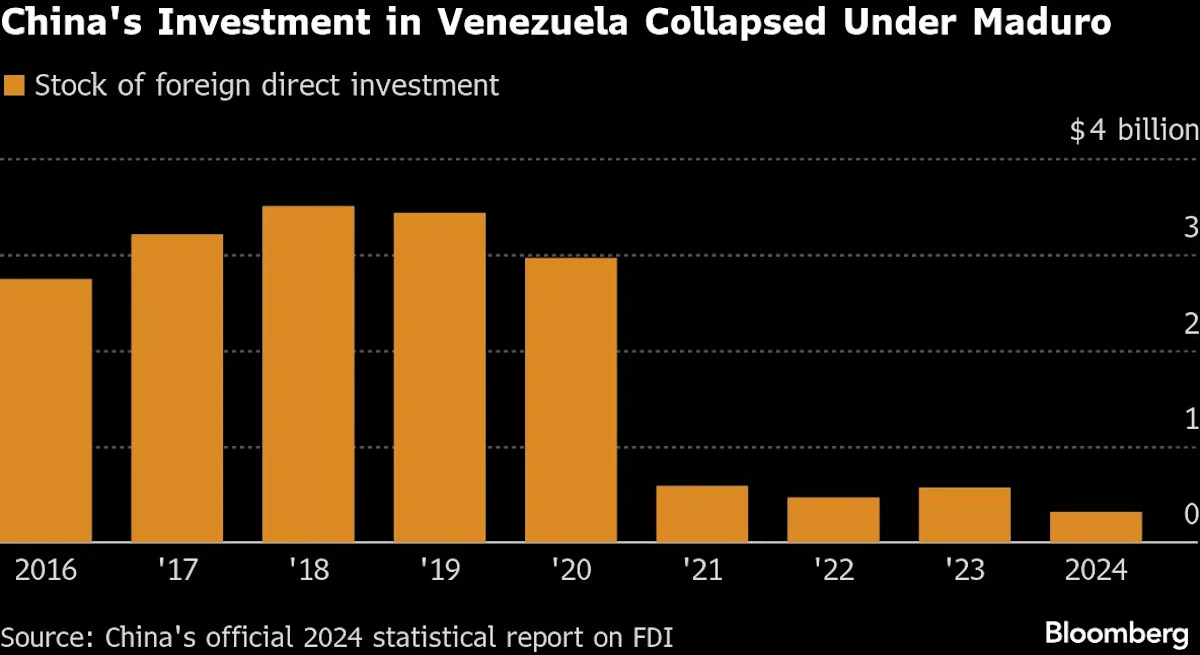
China has reduced its exposure to Venezuela in recent years and Trump would likely struggle to replicate the scale of his actions in Venezuela elsewhere, meaning for Beijing the implications are more political than economic.
A more interventionist US risks bumping up against China’s broader interests in South America, said Christian Reyes, a Beijing-based political risk analyst originally from Ecuador.
“Venezuela isn’t necessarily a precedent for direct expropriation, but it may be a precedent for coerced exclusion,” he said. “The United States is increasingly willing to define parts of the region’s economic relationship with China as a security concern and to leverage considerable influence to enforce those red lines.”
China’s reaction so far has been relatively muted. Foreign Ministry spokesperson Guo Jiakun said China’s legitimate rights and interests in Venezuela “must be protected,” at a regular briefing in Beijing on Thursday. “Cooperation between China and Venezuela is protected by international law,” he added. “It doesn’t concern any third party.”
Ahead of President Xi Jinping’s first state visit to the US in over a decade this month, officials from the world’s top economies are seeking to avoid any major bust-ups, even as they clash on issues from trade imbalances and Beijing’s economic support for Tehran.
For Beijing, Venezuela has become a less important source of energy in recent years. Crude from the country accounted for only 4% of the country’s total oil imports in 2025. No Venezuelan cargoes have been recorded arriving in China since the Trump administration assumed control of the assets following the capture earlier this year of then President Nicolás Maduro.
The bigger blow might be to the billions of dollars in debt owned to Chinese banks, which is tied to undelivered oil barrels. While Caracas stopped publishing detailed information about such liabilities after its sovereign default in 2017, the total debt pile to China was believed to total at least $10 billion as of 2025.
That figure has already come down considerably from its peak. China first began financing Venezuelan infrastructure and energy projects in 2007 under former President Hugo Chávez. Publicly available data suggests Chinese state banks had extended more than $60 billion in oil-backed lending to the country by 2015.
As US sanctions on Caracas intensified over the following years, China emerged as Venezuela’s largest crude customer and its most significant foreign creditor. State-run companies including China National Petroleum Corp., the parent of PetroChina Co., and China National Offshore Oil Corp. developed oil and gas projects in the Orinoco heavy-oil belt and elsewhere.
Chinese private firms, among them Concord Resources, also invested into stakes in upstream assets.
But the operating environment became increasingly difficult as Venezuela’s economy deteriorated and production facilities ran well below their intended capacity. Such moves accelerated after the US sanctioned Venezuela’s oil sector in 2019, although some legacy Chinese joint ventures and contracting staff including those from CNPC may still remain in Caracas.
That means claims the US is taking back oil fields from foreign adversaries won’t have a huge impact on Chinese companies, which had scaled back as Beijing’s strategic priorities evolved.
The bigger hit might be to Chinese refiners, already suffering from disruptions to their supply from Iran.
Independent processors in Shandong province, in particular, have long relied on Venezuelan heavy crude as a feedstock for bitumen production. The loss of those supplies has tightened the domestic bitumen market, helping drive futures prices sharply higher.
For most Chinese companies and creditors in Venezuela, the risks of doing business were already well known, analysts say, meaning the latest upheaval won’t come as a shock.
“South America has long been a geopolitical crossroads where the interests of China and the US intersect and, at times, collide,” said Liao Na, founder of energy research focused firm GL Consulting. “Given the importance both powers attach to Venezuela, friction is almost inevitable whenever their interests overlap.”
–With assistance from Philip Glamann, Jennifer A. Dlouhy and Iain Marlow.
Most Read from Bloomberg Businessweek
©2026 Bloomberg L.P.