

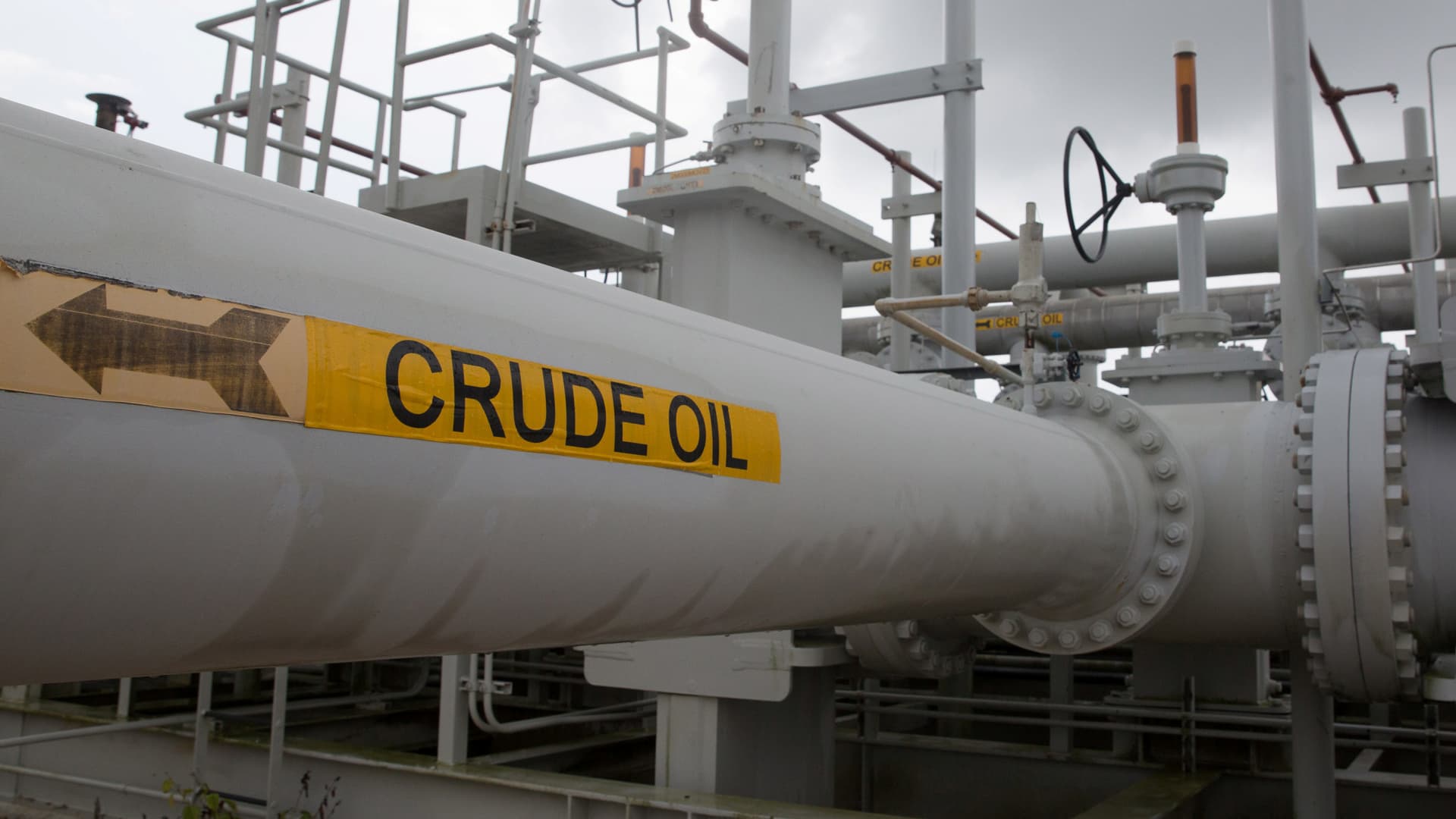
The geopolitical environment has evolved rapidly over the past week, but markets still see de-escalation as the base case because it remains in the best interests of all sides. However, if the current status quo persists for even a few more months, it could upend global energy and shipping markets sending prices soaring. Many investors may wonder how the price of West Texas Intermediate crude fell into the upper $60s a barrel following a ceasefire between Iran and the U.S. and even with Thursday’s surge prices are just above $90 following a wider resumption of hostilities . A lot of that has to do with the release of strategic reserves: 400 million barrels from 32 International Energy Agency member countries including the U.S. and Japan as well as a significant release of stockpiles from China, which has the world’s largest reserve. Tankers escaping the Persian Gulf during the ceasefire also added to supply. These increases in supply are only temporary. The U.S. SPR is now at its lowest level since 1983, less than 60 million barrels above its statutory minimum. The current release will only keep the market supplied for a few months, maybe until the end of the year if releases are dialed back. That could mean much higher prices if the Strait of Hormuz remains effectively closed into the fall, an outcome that may now be much more likely. “We think investors may be underappreciating the risk that the conflict persists and oil prices gradually move higher over the summer. This is not our base case, but if it were to materialize, it could challenge our expectation that inflation remains relatively contained through the summer,” Wolfe Research analyst Stephanie Roth wrote on Tuesday. Little room to maneuver For now, both sides have chosen conflict over negotiations. As a result, Iran has intensified its campaign, expanding attacks on commercial shipping, U.S. military bases, and critical infrastructure across the Gulf states. Its strategy appears to be driven by a narrowing window of opportunity: Iran’s greatest leverage lies in inflicting as much disruption as possible before defensive measures to protect shipping vessels can be fully deployed and alternative export routes, including bypass pipelines, become operational. Those longer-term solutions are unlikely to be in place before 2027. Against that backdrop, Piper Sandler analyst Andy Laperriere wrote Wednesday that President Donald Trump has little room to maneuver, “there is no “diplomacy” option available. He can either fight — with likely unsatisfactory results) or surrender control of the Strait of Hormuz to Iran. For now, he chooses to fight.” The U.S. response has taken the form of daily airstrikes targeting Iranian infrastructure, while military planners are reportedly considering a broader expansion of the conflict that could ultimately include a ground invasion. The strategy has also expanded beyond traditional military targets. U.S. forces are now reportedly striking empty tankers bound for Iran’s largest oil export terminal at Kharg Island, preventing Tehran from using those vessels as floating storage. By limiting Iran’s ability to store unsold crude offshore, the campaign increases the likelihood that oil production will have to be shut in more quickly. Meanwhile, the disruption to global shipping is likely to persist regardless of declarations that the Strait of Hormuz is “open.” Following the deaths of several sailors in recent attacks , tanker captains and their insurers are expected to remain far more cautious about transiting the Strait. Tolerance for price hikes Trump’s speech on July 16 on the vulnerabilities of the U.S. election system may indicate his acceptance that Democrats will make significant gains in the midterms and that he is looking for alternative ways to discredit the results. If he sees the midterms as unwinnable, the actual votes matter less, which means protecting inflation and oil in gas prices in the short term becomes less important. By accusing the Chinese government of tampering with 2020 elections he is straining relations with perhaps the only country that has enough oil reserves left to keep prices down just ahead of President Xi Jinping’s September trip to Washington, D.C. The preparation of new tariffs is also an indication he is tolerant of near-term price increases. It’s not just the oil market that is being disrupted, intelligence firm Kpler said 20% of the global supply of oil, LNG and helium, 16% of alumina, 15% of petrochemicals and 14% of fertilizers transit through the Strait. Additional disruptions outside the strait are also flaring up. At the southern entrance to the Red Sea, the Houthis in Yemen have reportedly attacked two Saudi oil tankers for allegedly violating their blockade, a development that will cause further disruption to a critical global trade route. Ukrainian attacks on Russian refineries have taken more than half of its capacity offline. Meanwhile, more than 100 Russian vessels — many exporting crude — in the Black Sea and Sea of Azov have come under fire, further limiting Russia’s ability to export oil and refined products. Additionally, a bipartisan bill to impose 100% secondary tariffs on countries such as China and India that buy Russian oil and gas is reported to have a filibuster-proof majority for passage in the Senate. Such tariffs will push overall prices even higher. Demand destruction Most analysts argue that oil prices have limited room to move higher because demand destruction will ultimately cap the rally. Although there were some early signs of weaker fuel consumption in lower-income Asian economies as the conflict began, that argument appears less convincing in the United States. Anecdotally, I have not noticed any reduction in road traffic, implying consumers have so far absorbed higher fuel costs with little change in behavior. Morgan Stanley Equity Strategist Michael Wilson noted that “airline demand and booking intent remain healthy, with seven consecutive price increases absorbed without demand destruction.” Equity markets also seem to have been relatively immune to current energy price levels. “$110/bbl was where we started to see meaningful financial stress earlier this year,” Deutsche Bank Macro Strategist Henry Allen wrote in a recent note. “Once you get to that point, it also risks creating a self-fulfilling prophecy (as in 2022), whereby tighter financial conditions and equity declines induce a pullback in consumer spending and a dent to growth in and of itself,” he said. @CL.1 YTD mountain West Texas Intermediate crude oil year to date Oil volatility has also become a bigger risk to specific companies with exposure. United Airlines recently introduced “a new policy to base its guidance on the most current fuel prices.” Once strategic reserves begin to run low oil prices will need to adjust higher if current disruptions continue. Unlike the Covid-19 pandemic where the government could print more money to fund a massive fiscal response, there is no way to conjure oil out of thin air. The U.S. will have two additional options. The first would be to ban exports of U.S. oil. “Curtailing US oil exports would likely backfire, failing to cut domestic energy prices while causing unintended consequences that would harm global energy security,” the Atlantic Council said . The second would be to announce another SPR release. A Department of Energy spokesperson recently said that minimum operational level of the SPR is about 70 million barrels, below the generally accepted industry standard of 250 million barrels. Even if drawing it down to these levels doesn’t collapse the salt caverns, flows would slow considerably once the caves close in on empty. This is where panic could set in and actually push prices higher. When the war started Trump said it would likely last four or five weeks but could go on much longer. Now after passing the 20 th week, it’s safe to say that we have entered the “much longer” phase. Another 20 weeks of war that include a de facto closure of the Strait of Hormuz will test global oil stockpiles and push prices higher on a myriad of goods that rely on “black gold” in their production and transit. THIS CONTENT IS PROVIDED FOR INFORMATIONAL PURPOSES ONLY AND DOES NOT CONSTITUTE FINANCIAL, INVESTMENT, TAX OR LEGAL ADVICE OR A RECOMMENDATION TO BUY ANY SECURITY OR OTHER FINANCIAL ASSET. THE CONTENT IS GENERAL IN NATURE AND DOES NOT REFLECT ANY INDIVIDUAL’S UNIQUE PERSONAL CIRCUMSTANCES. THE ABOVE CONTENT MIGHT NOT BE SUITABLE FOR YOUR PARTICULAR CIRCUMSTANCES. BEFORE MAKING ANY FINANCIAL DECISIONS, YOU SHOULD STRONGLY CONSIDER SEEKING ADVICE FROM YOUR OWN FINANCIAL OR INVESTMENT ADVISOR. Click here for the full disclaimer.
Running on borrowed time: The world’s oil buffer is shrinking as inflation risks build

About the author