

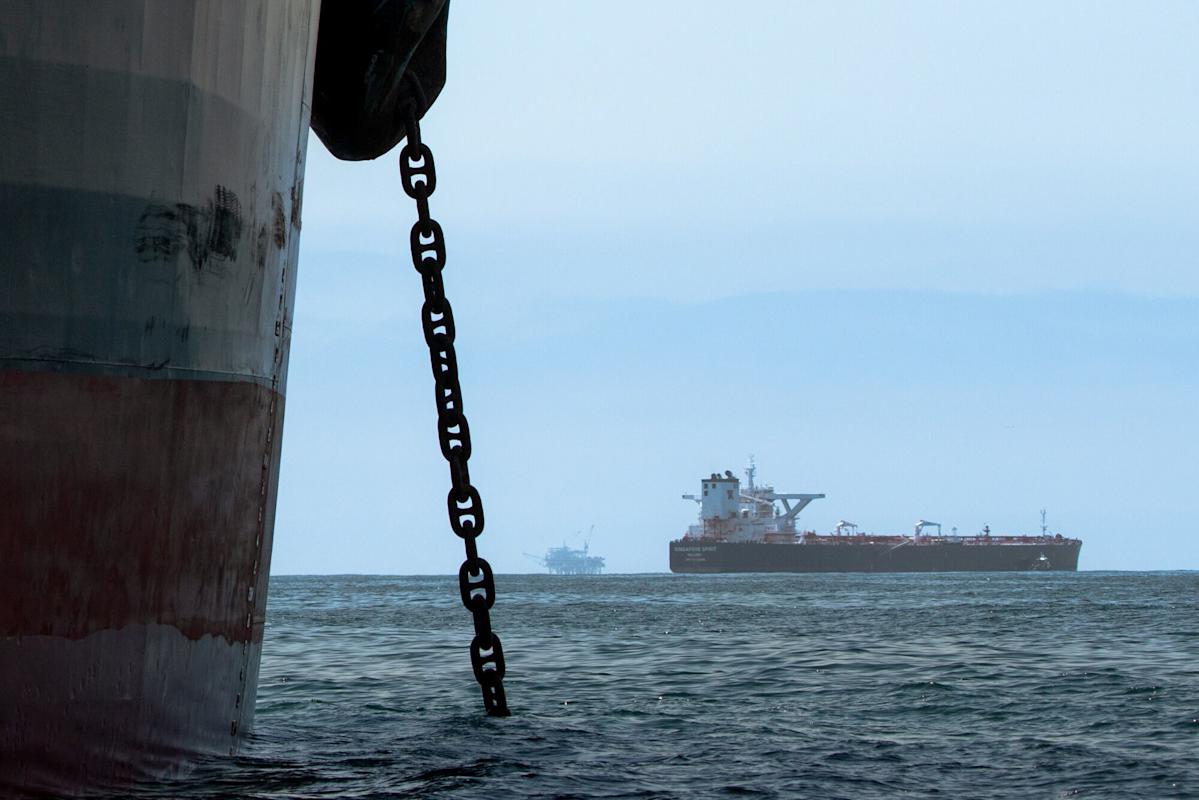
(Bloomberg) — A Chinese oil supertanker appears to have exited the Strait of Hormuz as it sails toward an area where the US has enforced a blockade, ahead of talks between US President Donald Trump and counterpart Xi Jinping.
Most Read from Bloomberg
Supertanker Yuan Hua Hu moved through the waterway on Wednesday, past Iran’s Larak island, and into the Gulf of Oman, ship-tracking data show. The vessel is owned and operated by units of China’s Cosco Shipping, according to shipping database Equasis.
The transit — only the third by a Chinese very large crude carrier since the war began — comes at a delicate time. A long-awaited leaders’ summit this week will touch on topics including the war in the Middle East and Beijing’s perceived support for Tehran. China’s private refiners have been major buyers of Iranian crude for years, providing a financial lifeline.
While the US has vacillated in its stance on Iranian oil through the conflict, it has since cranked up pressure on the trade with China, sanctioning players including mega processor Hengli Petrochemical Dalian Refinery Co Ltd. The company has denied the allegations.
The ship is currently signaling the Chinese port of Zhoushan as its next destination. It had earlier broadcast its affiliation with Beijing by declaring its Chinese ownership and crew, a strategy widely used as a safety mechanism, especially among vessels using the Tehran-approved route through the strait that runs along Larak Island.
Yuan Hua Hu’s draft indicates it’s fully loaded with oil, or close to the vessel’s 2 million barrel capacity. It was seen lifting from Iraq’s Basrah terminal in early March, according to ship-tracking data. The vessel was chartered by Unipec, the trading arm of Chinese state refining giant Sinopec, according to a fixture seen by Bloomberg.
It’s unclear if the ship will make it through the US blockade, which has been set up around the area where the Gulf of Oman meets the Arabian Sea. In recent days, erratic movements by other tankers including u-turns and failed crossings have been observed. Signals issued by ships in the area are often impacted by electronic interference, or spoofing, which can complicate monitoring and may misrepresent their locations.
Captains can also turn off vessels’ transponders for security reasons.
(Updates with apparent location of vessel and its reported charterer.)