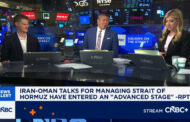

U.S. stock futures fell Thursday, weighed by higher oil prices, as traders followed the latest developments out of the Middle East.
S&P 500 futures and Nasdaq 100 futures shed 0.8% and 1%, respectively. Futures tied to the Dow Jones Industrial Average fell by 351 points, or 0.8%.
Crude prices rose on Thursday, putting pressure on equities. Brent futures jumped 3.8% to $106.07 per barrel. West Texas Intermediate climbed 3.5% to $93.45.
Iran’s foreign minister reportedly told state media on Wednesday that top authorities in the Middle Eastern nation are reviewing an American proposal to end the war, but Tehran has no intention of having talks with the U.S.
On Thursday, however, President Donald Trump said in a Truth Social post that Iran “better get serious soon, before it is too late, because once that happens, there is NO TURNING BACK, and it won’t be pretty.”
Gulf countries also issued a joint statement Thursday condemning Iran’s “criminal” strikes on their energy infrastructure. They added that they are ready to defend themselves going forward. “While we value our fraternal relations with the Republic of Iraq, we call on the Iraqi government to take the necessary measures to immediately halt the attacks … toward neighboring countries,” the joint statement.
Wall Street is coming off a winning session, putting the major averages on track for a winning week. But Kate Moore, chief investment officer of Citi Wealth, believes that investors seem too sanguine that a resolution is coming.
“Some of the price action we’ve experienced, especially in the last two trading days, is basically showing, I think, a huge amount of optimism that we’re going to have a resolution and not a broad-based inflationary impact from the shock in energy,” she said on CNBC’s “Closing Bell: Overtime.” “That makes me a little bit nervous, if I’m honest.”
“I want to be very, very thoughtful about how we construct portfolios because we want to build for resilience right now, and we want to make sure that we’re shored up against both the inflationary risks and what might be more kind of prolonged conflict than I think the optimists in the markets were pricing in today,” she added.
—CNBC’s Kevin Breuninger contributed reporting.
Crude prices rise in early trading

— Fred Imbert
Asia-Pacific markets close lower as Iran rules out direct U.S. talks despite reviewing proposal
Asia markets trade mixed as Iran rules out direct U.S. talks despite reviewing proposal
Asia-Pacific markets traded mixed on Thursday after Iran signaled it had no intention of holding direct talks with the United States, even as Tehran reviews an American proposal to end the war, according to the Islamic Republic’s foreign minister.
Iranian Foreign Minister Abbas Araghchi said that an exchange of messages between the two countries through mediators “does not mean negotiations with the U.S.,” Reuters reported.
Earlier Wednesday, Iranian state media reported that the country would reject a U.S. ceasefire offer and had outlined its own conditions for ending the war.
Australia’s S&P/ASX 200 was little changed.
Japan’s Nikkei 225 added 0.28%, while the Topix rose 0.43%. South Korea’s Kospi slid 1.55% and the small-cap Kosdaq added 0.18%.
Hong Kong’s Hang Seng index slid 0.52%, while the CSI 300 opened flat.
—Lee Ying Shan
Stocks making the biggest moves after the bell: Worthington Steel, Karman and more
These are the stocks moving the most in extended hours trading:
- Worthington Steel — Shares plummeted nearly 15% after the steel processing company posted fiscal third-quarter adjusted earnings of 27 cents per share, marking a decline from the 35 cents per share earned in the year-ago period.
- MillerKnoll — The furniture stock plunged 18%. MillerKnoll posted fiscal third-quarter adjusted earnings of 43 cents on revenue of $926.6 million.
Read the full list of stocks moving here.
— Lisa Kailai Han
Nine of the 11 GICS sectors end Wednesday’s session higher
On Wednesday, nine of the 11 GICS sectors ended the session higher.
Gains were led by the materials sector, which added 1.97% during the session, and followed by consumer discretionary stocks, up 1.18% on the day.
On the other hand, energy and real estate were the day’s laggards. The sectors respectively fell 0.53% and 0.04%.
— Lisa Kailai Han
Stock futures open little changed
Stock futures opened near flat on Wednesday night.
Futures tied to all three major averages fell marginally below the flatline.
— Lisa Kailai Han