
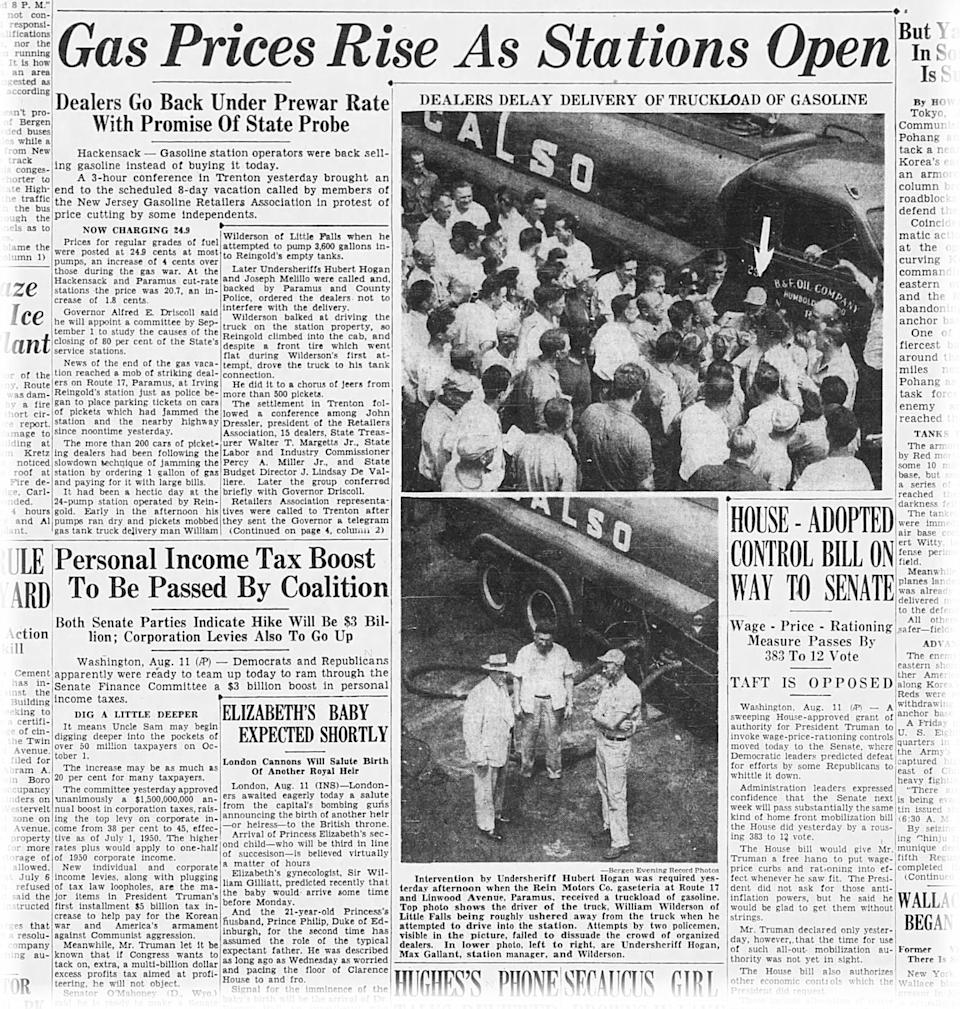
Cars lined up for blocks at Irving Reingold’s new 24-pump mega-station in the summer of 1950, drawn to Paramus by gas prices few other New Jersey stations could match.
Just a year earlier, Reingold’s push to sell gas at a cut rate through self-service pumps had triggered a law forcing attendants behind every tank — a quirky, yet beloved state law that still stands as the nation’s only ban on self-service. Now, Reingold was back, sparking a price war so fierce it pulled the governor into the fight after a strike closed about four in five gas stations statewide.
Born in Newark on Dec. 29, 1915, Reingold would eventually own a controversial go-go lounge turned gay bar in Hackensack and shoot a man in self-defense during his 82 eventful years. The first half of his life, however, was deeply rooted in the automotive industry.
Reingold said he left home at the age of 11 and found work within a year as a chauffeur for famed Catskills resort owner Jennie Grossinger. By 21, he had purchased a tire and car dealership in Ridgefield Park, the first of several, and he eventually secured what might have been New Jersey’s first Hertz rental franchise at 175 Essex St. in Hackensack.
Advertisement
It was there, where he had built his Rein Motors headquarters at the age of 32, and just a year later, he attempted to change the state’s driving landscape through his “Gaseteria.”
The gasoline station was born in 1905
The nation’s first dedicated gasoline station opened in 1905, when the Automobile Gas Company began operating in St. Louis, according to “The Gas Station in America” by John A. Jakle and Keith A. Sculle. By 1920, more than 20,000 service stations were pumping fuel nationwide, a number that grew exponentially over the next few decades, the authors note. Before purpose-built stations, gasoline was typically sold in cans at general stores or pharmacies, leaving motorists to fill their tanks on their own.
Service stations changed the way people bought gas and gradually expanded to include car washes, convenience stores and restaurants. For decades, “full service” was the industry norm. Reingold wanted to give the pump back to the people.

He introduced self-service and offered unbranded gas 4 cents cheaper per gallon than competitors, saying he was effectively passing along the savings from the new system.
Advertisement
Advertisement
He offered a $10,000 reward for anyone proving his petrol was inferior to that being sold at about 25 cents a gallon and put up signs that said “Save 4 Cents.” His success drew the ire of brand-beholden dealers. They could not prove his gas was low-quality, as he later said it was branded gas he bought wholesale. But they did successfully challenge his signs in courts for false advertising. After further intimidation efforts failed, they turned to lawmakers to end his advantage.
The self-service gas station debuted
Self-service gas stations began appearing in the 1930s but did not spread widely until the 1960s, according to Jakle and Sculle. Even then, many states prohibited it. Indiana passed the first ban in 1930, and by 1948, nine states had enacted similar restrictions.
Supporters of these laws argued they were necessary for public safety. Monmouth University professor Robert H. Scott III, in a 2007 Challenge article, notes that early gasoline pumps lacked many of today’s safety features and that fire hazards were a central concern. Other reasons cited over the years ranged from crime prevention to avoiding situations where children were left unattended.
Story continues below photo gallery.
Scholars, however, point to economic self-interest as a more likely driver. Robert L. Bradley, in “Oil, Gas, and Government: The U.S. Experience,” documented how trade groups, labor unions and large station owners lobbied to block self-service to shield themselves from price competition. That lobbying happened quickly in New Jersey.
The man behind New Jersey’s gas price war of 1950
Reingold opened his Hackensack “Gaseteria” in January 1949. Four pumps with 25-foot hoses, automatic shutoffs, nearby fire extinguishers and no-smoking signs were available for customers. By the end of March, there was a bill in the New Jersey Legislature seeking to ban self-service stations to prevent the careless and ineffective sale of gasoline. Governor Alfred E. Driscoll signed it into law that June.
Advertisement
Advertisement
Reingold would not only challenge the law in court, but also retaliate in the best way he knew how. He built the largest gas station anyone in the area had ever seen to undercut the competition through bulk sales.
In April 1950, he opened a 24-pump station at Route 17 and Linwood Avenue in Paramus. Dubbed the nation’s largest, its pumps could dispense 25 gallons a minute, twice the speed of most pumps. They were a key part of Reingold’s plan to move 15 million gallons a year between the two locations. Hackensack alone had been doling out 3.6 million gallons annually, he told the press at the time.
By the summer of 1950, Reingold was selling gasoline at 18.9 cents a gallon from his Rein’s Gaseteria stations in Paramus and Hackensack. The Sun Oil Company, one of the largest suppliers, reacted, cutting its dealer price for Sunoco stations from 24.3 cents to 21.3 cents. Company vice president Frank R. Markley told the press the move was meant to help dealers compete, but Sun was nonetheless blamed for widening the conflict Reinhold proudly claimed as his creation. Station prices dropped, but the wholesale prices the dealers paid did not.
John Dressler, president of the New Jersey Gasoline Retailers Association, warned that some stations — locked into fair-trade laws that kept prices above 24 cents — might be forced to close if the price war continued unchecked. On Aug. 9 of that year, the association called a weeklong strike, sending members to block open pumps and urge independents to shut down.
Advertisement
Advertisement
All the stations along Route 4 were closed, as were 70% of stations in Hudson County. About half remained open along Route 17, including Reingold’s mega station in Paramus, which had newly armed security. However, even with two officers on scene on Aug. 10, about 200 dealers — some from still-operating stations — gathered at Rein’s in Paramus, clogging the lot and heckling customers in an unsuccessful strongarm attempt to get him to raise prices to 20.9 cents per gallon. At one point, the mob stopped a delivery by knocking the fuel hose from Little Falls driver William Wilderson’s hand and shoving him back into his truck.
As they left, one strike leader shouted, “Bet you feel like a hero.” Reingold smiled and answered, “I do.”
That evening, the association members called off the strike, and by the next morning, prices began rising as high as 24.9 cents. Reingold raised his to 20.7, and Driscoll vowed to appoint a committee to study price fixing. Still, it only took a week for Sun Oil to reverse course and for Reingold and Dressler to predict another war.
Reingold reverted to his original strategy to counter Sun Oil dealers. On Aug. 17, he cut prices to 18.9 cents. He also announced intentions to use his million-dollar war chest to buy 40 stations and drive his rivals into bankruptcy. Dressler responded by vowing to use association funds to subsidize prices of 16.9 cents per gallon to undercut Reingold and force the state to pass a law to regulate pricing.
Advertisement
Advertisement
The Record’s editorial board criticized the tactics on all sides, calling the dispute “a costly and for many little businessmen a disastrous stunt,” and accusing participants of seeking legislation to regulate undercutting rather than competing through service, efficiency and brand value. Reingold became president of Fighters of Free Enterprise, a network of independent dealers opposing price fixing, and in September 1950 cut a deal with the association that he would price his unbranded gas 2 cents less than their branded products.
The deal was bolstered by a study from the Retail Gasoline Dealers Association following the 1949 self-service experiment that found that only 15% of Hackensack drivers were seeking cut-rate fuel. The study’s authors ultimately urged members to improve service instead of chasing price.
New Jersey upholds the self-service law
Just a few months later, in January 1951, Reingold’s challenge on the self-service law reached the New Jersey Supreme Court, which upheld the 1949 law with a 4-2 vote. The majority opinion came with an admission that one of the aims of the law was to eliminate low-priced competition, but it maintained that the law was designed with safety in mind and should be upheld.
Thwarted once again in his pursuit, Reingold reignited the price war in the summer of 1951. Despite making the 2-cent buffer agreement, Sun Oil’s affiliates had lowered their prices to 22.9 cents per gallon when Reingold was selling for 21.9. He immediately lowered his price to 16.9 cents and pushed the gas prices as low as 13.9 cents in February 1952 before state officials stepped in. The politicians’ widely mocked plan to reduce competition: limit the size and number of price signs at gas stations to 7.5-by-9-inch cards.
Advertisement
Advertisement
Reingold responded by attaching an 8-foot-by-8-foot sign to the body of a truck tethered to a utility pole outside his Paramus service station in yet another battle of a war that simmered until the middle of the decade. While Reingold lived relatively under the radar for the next two decades, he eventually got into other ventures that stirred attention as much as profit.
Who was the man behind the gas price wars of the 1950s?
In the spring of 1975, Reingold opened The New Bell along Route 4 in Hackensack, drawing crowds with male go-go dancers performing for female patrons. The format sparked protests from residents and a lawsuit from a Teaneck police officer, who claimed the club’s “Girls Nite Out” policy discriminated against men. Before the case reached a conclusion, Reingold shifted course, remaking the venue into a bar for gay men, believed to be the first in Bergen County.
The change brought steady customers but also scrutiny from the state Division of Alcohol and Beverage Control. Reingold spent months in court fighting accusations ranging from lewd conduct to liquor and fire code violations. He lost each case.
Weeks after the club opened in 1975, Reingold returned home to Teaneck with the night’s receipts at about 2:30 a.m. on May 28, when an armed man jumped out from behind the front bushes. Reingold drew a .357 Magnum and shot him once in the chest, killing him. Authorities declined to file charges. Reingold, who died in August 1998 at his home in Madeira Beach, Florida, later suggested the man had been hired to kill him.
Advertisement
Advertisement
This article originally appeared on NorthJersey.com: This man is the reason we don’t pump our own gas in New Jersey