


As a second-grade teacher, Francine Gauthier, 54, was used to feeling a little tired and having the occasional aches and pains.
But Gauthier, of Lafayette, Louisiana, started to notice some other odd symptoms.
Starting around April of 2025, she began feeling full quickly after meals and developed nausea and heartburn. But, having just started a GLP-1 medication for weight loss, she assumed her symptoms were side effects.
Advertisement
Soon, she also began feeling noticeably fatigued. Gauthier tells TODAY.com that her fatigue was “extreme. (I was) just very, very tired. I could sleep 10 to 12 hours and still wake up tired.”
At her age, Gauthier thought her tiredness might be due to post-menopausal hormone changes. And when the school year started up again in the fall, she thought that might be making her tired, too.
On Sept. 29, shortly after she developed back pain, Gauthier’s son passed away — and the loss was crushing. She’d already lost her other son several years ago, and she’s now raising her two grandkids, ages 11 and 9.
Francine Gauthier had symptoms including fatigue, weight loss and back pain that she attributed to hormonal changes and life stress. (Courtesy Francine Gauthier) (Courtesy Francine Gauthier)
“I was blaming the fatigue, tiredness and nausea on just being sick. Like, my son’s gone,” she says. “I don’t know how to explain it, but it was just very overwhelming all the different things that were happening to my body.”
Advertisement
Advertisement
She started seeing a chiropractor for her back pain, which helped a little, “but I was living on heating pads, Advil and massages,” Gauthier says. At the same time, her fatigue got worse, and she found herself needing a caffeine boost earlier and earlier in the day.
“I started drinking more energy drinks and more Diet Cokes so I could just make it through the day,” she says. “By 10 or 10:30 a.m., I was so exhausted I was popping open a Diet Coke. Before, it was one cup of coffee and water all day.”
Gauthier also started to notice her weight changing after the death of her son. In October, she had started to space out her GLP-1 shots to every other week, but she was still losing weight.
“I didn’t have a shot for the whole month of December, and I was still dropping weight,” she says. “I dropped probably 10 pounds within three to four weeks.”
Advertisement
Advertisement
Her pain was so excruciating in December that she couldn’t do any of the holiday activities she loves — her Christmas tree wasn’t decorated, she couldn’t cook and she had to do all of her shopping for gifts online. “Those were all things completely out of the norm for me,” she says.
By January, Gauthier noticed her urine getting darker.
And, finally, on Feb. 10, 2026, “When I woke up, my urine was chocolate brown,” she says. Her skin and eyes were jaundiced (yellow), too, so she and her husband rushed to the emergency room.
Tests Revealed Advanced Pancreatic Cancer
At the hospital, Gauthier’s lab tests showed her bilirubin levels were “off the charts,” she says, potentially indicating an issue with her bile ducts or liver.
Advertisement
Advertisement
An ultrasound and, later, a CT scan, revealed that she had a mass on her pancreas about 4.7 centimeters.

Francine Gauthier and her husband Richie travel to MD Anderson Cancer Center for treatment. (Courtesy Francine Gauthier) (Courtesy Francine Gauthier)
“From that point, everything started moving pretty quickly,” Gauthier says, and she started seeing multiple doctors to learn more about her tumor.
The tumor had grown around a major artery, as well as other nearby veins, and it had begun to push up against one of her bile ducts, which transports bile within the body. That’s what caused her bilirubin levels to skyrocket and the jaundice.
So, the first step was for doctors to place a temporary stent to open up her bile duct. During that procedure, her medical team also performed a sweeping biopsy of the tumor, which came back with inconclusive results.
Advertisement
Advertisement
At that point, Gauthier and her husband decided to seek more specialized care at the University of Texas MD Anderson Cancer Center.
Gauthier’s Stage 3 pancreatic cancer is an adenocarcinoma, the most common type, Dr. Matthew Katz, Gauthier’s oncologist at MD Anderson, tells TODAY.com.
But the way her tumor has grown makes surgery virtually impossible, he explains.
“She has disease that wraps around multiple blood vessels that supply blood to her small intestine, as well as her liver, stomach, spleen and essentially her entire mid-gut and foregut,” Katz says.
With so many organs impacted, it’s not really a question of whether the surgery is too challenging, he explains, “It’s just a question of being able to do it and reconstruct the anatomy in such a way that (gives her) a reasonable quality of life.”
Advertisement
Advertisement
For now, Gauthier is undergoing chemotherapy every two weeks for the next four to six months. After four months, she’ll get imaging to check in, and “maybe something positive happens,” she says.
Remaining Hopeful as Treatment Begins
Gauthier says her “world stopped” when she got the diagnosis.
Her symptoms made her wonder if cancer was a possibility “in the back of my mind.” But with no genetic risks for pancreatic cancer and no obvious lifestyle risk factors, it still came as a shock.
In addition to her treatment, Gauthier is working on improving her diet to stay as healthy as possible while she goes through chemotherapy. She’ll get imaging done at the end of this month to check how the treatment is progressing and will meet with Katz in April to discuss her next steps.
Advertisement
Advertisement
Looking back, Gauthier recognizes how each of her symptoms was easily explainable by something other than cancer. But, taken together, her fatigue, back pain, weight loss and other issues became an alarming combination.
And she hopes her story can be an example to others to take their symptoms seriously. “My message is to not ignore your body,” she says. “When it’s when it’s excruciating, it’s impacting your quality of life and you just want to cry, that’s when you take it in your hands and go get the scan done.”
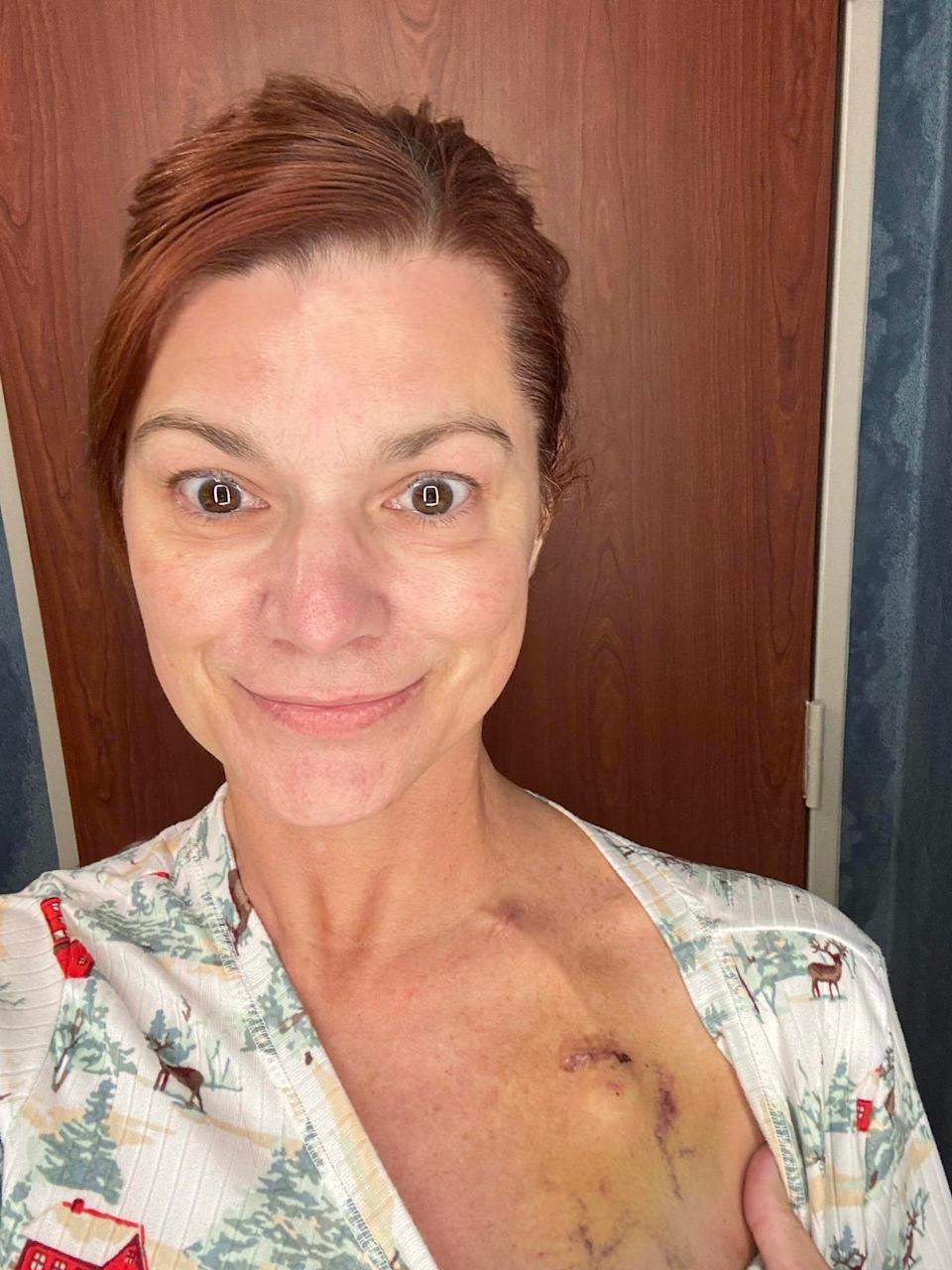
Francine Gauthier has shared real-life updates on her social media pages, including her chemotherapy port placement. (Courtesy Francine Gauthier) (Courtesy Francine Gauthier)
Of course, not everyone with back or stomach pain should rush to their doctor, Katz says. But symptoms that don’t go away or get worse — even if they seem “relatively innocuous or benign” — should be evaluated, he says.
Unexplained weight loss, increasing fatigue and back pain that doesn’t go away aren’t always symptoms of pancreatic cancer, Katz says, but they are concerning.
Advertisement
Advertisement
Weight loss in particular can be hard to parse, he says, with so many patients now taking GLP-1 medications. It’s possible that, as in Gauthier’s case, they could mask or provide a false explanation for weight loss that would be concerning in other circumstances.
Now, Gauthier is navigating the ups and downs of treatment, and learning how to make chemotherapy a little more comfortable (an eye mask helps with light sensitivity, for instance).
And she’s leaning on her strong community, sharing regular updates about life as a cancer patient on her social media pages. An online fundraiser to help cover her medical costs has raised nearly $54,000.
“The amount of support that our community has given us has just been phenomenal,” she says. “I can’t even put into words what that has done, as far as lifting me and carrying me because I’m scared.”
Advertisement
Advertisement
But with a plan in place, she says, “I have more knowledge, and I have more power.”
This article was originally published on TODAY.com