
A routine fuel stop turned into a national political flashpoint after a gas station employee refused service to federal immigration agents, igniting a debate that now reaches far beyond politics and squarely into the automotive and fuel retail space.
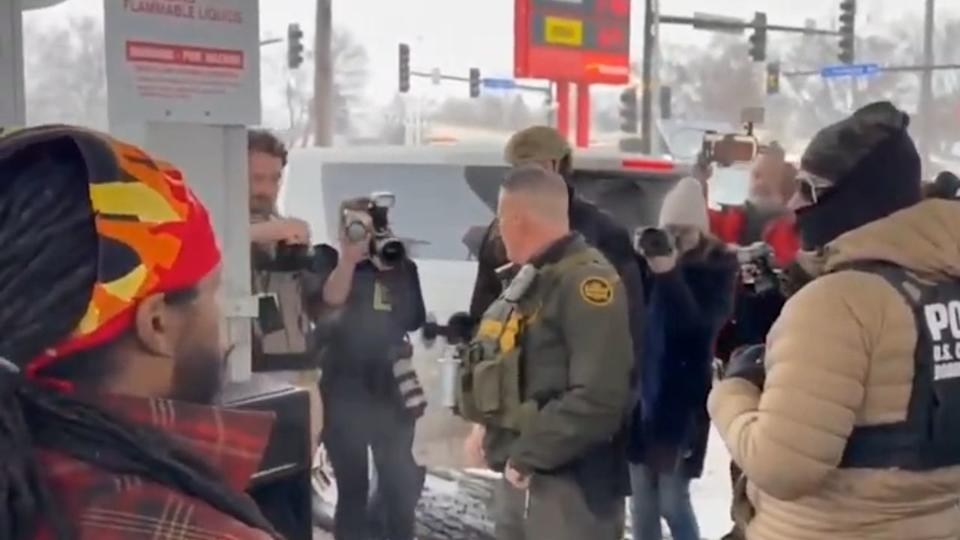
The incident unfolded at a Speedway gas station in Minneapolis when Border Patrol agents attempted to refuel government vehicles during official operations.
According to video footage that quickly spread online, a man identifying himself as the store’s manager denied service and stated bluntly that he did not support ICE, adding that no one at the store did either. The agents were told to leave without being allowed to purchase fuel.
Within hours, the encounter became a lightning rod. Critics accused the business of politicizing a basic commercial service, while supporters framed the refusal as a form of protest.
But for the automotive and fuel industries, the episode raises deeper questions about neutrality, safety, and the evolving role of gas stations in an increasingly polarized environment.
Fuel stations occupy a unique position in American infrastructure for the simple fact that they aren’t simply retail outlets. They are essential service points relied upon by private motorists, commercial fleets, emergency responders, and, yes, government agencies like ICE.
Denying fuel is not equivalent to refusing a cup of coffee or retail merchandise. Vehicles without fuel do not operate, and in the case of law enforcement or emergency services, that reality carries serious implications.
Industry experts note that while private businesses generally retain the right to refuse service, gas stations historically operate under an expectation of political neutrality. Fleet contracts, fuel cards, and government supply agreements are built on reliability, not ideology.
Once a station is perceived as selectively serving customers based on political or occupational identity, that reliability comes into question.
The fallout for Speedway and its parent companies has been swift. Calls for boycotts surfaced almost immediately, with critics warning that the brand risks alienating everyday drivers who view fuel access as nonpartisan.
Others warned of reputational damage that could ripple across franchise networks, where individual store decisions can reflect on national brands regardless of corporate policy.
There is also a safety dimension that automotive analysts are watching closely. Federal agents often refuel during active operations or long-distance deployments. Forcing vehicles to reroute in search of fuel introduces delays and unpredictability.
In urban areas, that may be inconvenient. In rural or high-risk environments, it can be dangerous.
The situation also highlights the growing vulnerability of frontline automotive workers. Gas station clerks and managers are increasingly finding themselves pulled into political confrontations they did not anticipate when taking the job.
Training for fuel retail employees rarely covers how to handle politically charged encounters with armed federal officers. Yet viral videos and instant outrage ensure that a single interaction can carry nationwide consequences.
this incident could prompt fuel chains to revisit internal policies. Clear guidance on serving government vehicles, emergency fleets, and law enforcement may become standard as companies seek to avoid similar controversies.
Some argue that neutrality clauses, similar to those used by utilities and transportation hubs, could soon appear in franchise agreements.
Whatever your political affiliations or feelings about ICE activities recently, the debate permeates deeper than immigration enforcement. It is also about whether access to fuel remains a shared civic baseline or becomes another arena for ideological expression.
Cars, trucks, and commercial vehicles power the economy. Gas stations power those vehicles. When service becomes conditional, the entire transportation ecosystem feels the strain.
The moral of this story for drivers watching from the sidelines is that, apparently, a government vehicle can be turned away today. So, who might be refused tomorrow? Ride share drivers? Delivery fleets? Commercial haulers?
What we know for sure (and probably care the most for) down here is that the automotive world depends on predictability, not political litmus tests.
With automobiles already at the center of debates over electrification, emissions, and affordability, has the simple act of refueling now entered the culture wars too? That may be the most combustible element of all.