

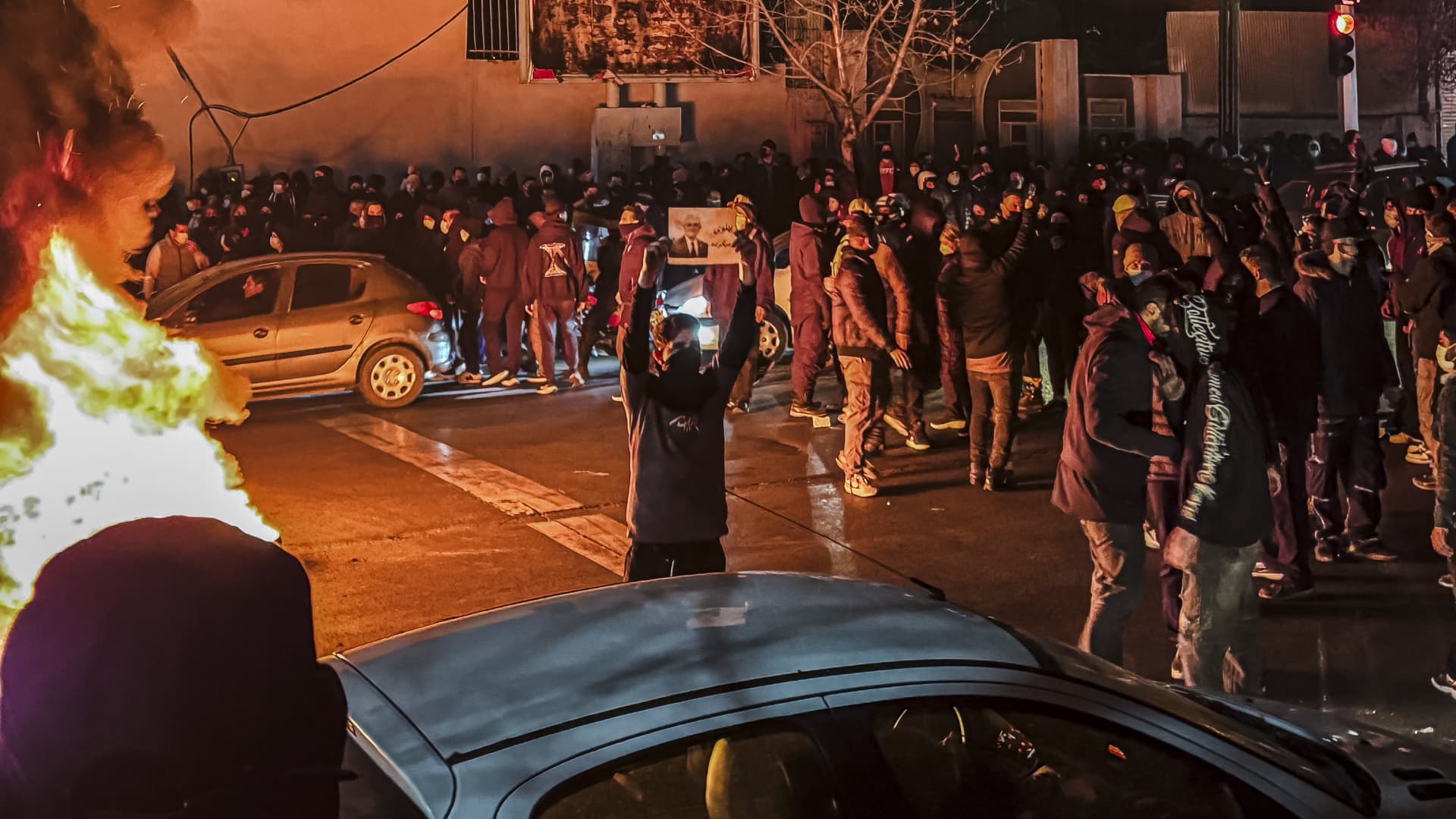
Energy markets have been rocked by volatility in recent days, as investors weigh a violent crackdown on civil unrest in oil-rich Iran – and the response from Washington. The possibility of U.S. military action against Iran was only the latest geopolitical development in 2026 to concern traders, following the seizure of the president of Venezuela, another oil-rich country, in a daring raid on Jan. 3. Oil prices extended gains seen in the previous session on Wednesday, after the U.S. and the U.K. were reported to be pulling personnel from a military base in Qatar, fueling speculation that a strike on Iran was imminent. But prices sank on Thursday after President Donald Trump appeared to step back from the brink. Global benchmark Brent crude oil dropped 3.7% on Thursday morning, with futures for March delivery last seen trading at $64.07 per barrel. Meanwhile, front-month West Texas Intermediate crude also lost 3.7% to settle at $59.71 a barrel. @LCO.1 5D line Brent crude price CNBC spoke to energy analysts and market participants about how they’re navigating the uncertainty. A ‘Choppy ride’ Marc Ostwald, chief economist and global strategist at London multi-asset brokerage ADM Investor Services, told CNBC that traders were bracing for further price swings. “Oil markets are very much subject to two opposing forces, and the overall profile of supply outpacing demand … leaving the market trading oil from the short side,” he said on Thursday. “On the other hand, the potential disruption to supply from geopolitical tensions in Iran and Venezuela leaves it vulnerable to short squeezes, particularly with that U.S. threat of 25% tariffs on any country trading with Iran.” However, he said that fears of further U.S. military interventions were overriding these issues, as traders were concerned that this could have implications for the critical shipping route along the Strait of Hormuz, or prompt Iranian retaliation against the Gulf states. “As long as those factors remain in play, it’s going to be a choppy ride,” he said. ‘No real change’ Ed Bell, acting chief economist and group head of research at Emirates NBD, one of the UAE’s biggest lenders, told CNBC’s “Access Middle East” on Thursday that, though markets were watching the situation closely, little had actually changed. “When it comes down to it, markets are going to be watching out for: Has there been a change to production in the critical Gulf producers? No. Has there been a change to oil supply or natural gas supply coming out from the Gulf to international markets? No,” he said. He added that investors’ outlooks could change if geopolitical tensions escalated around Iran, an OPEC member that produces around 3 million barrels of oil a day. “We have no indication that any of that has been interrupted as a result of the protest movement that we have seen in the last couple of weeks,” he said. “But clearly that is a substantial amount of oil that could be at risk if there is any further escalation or an aggravation of a military event.” Asked why markets were selling off on Thursday, Bell said the reaction was similar to many other geopolitical events in recent years, likening the movements to those seen after the U.S. joined Israeli bombardments of Iranian nuclear facilities last June. “You had a very rapid and aggravated move upward in oil prices, but as it became clear that there was no change to the fundamental picture, that sold off quite quickly – so we’re [now] seeing that encapsulated in a very short, kind of 48-hour time frame,” he said. “As no real change in the situation has materialized, and we have this cooling of the rhetoric coming from Trump, we are seeing markets react accordingly.” Bell’s team’s base case for oil this year, before the unrest in Iran, had been for a large supply of oil to enter the market, a modest rise in demand, and “a big inventory overhang.” He told CNBC he does not see that scenario changing. “Until we have any kind of real material change in the movement of molecules out of the region, then we will expect to see prices normalized back to what we had anticipated for 2026 prior to the focus on Iran,” he told CNBC. Geopolitical tensions lend price support Paul Jackson, global market strategist, EMEA, at Invesco, told CNBC by email on Thursday that he expected oil prices to get support this year from an accelerating global economy. “However, the price has recently been pushed in opposite directions by two geopolitical events,” he said, referring to hopes that Venezuela would rejoin global oil supply after the U.S. strike, and then the situation in Iran. “Geopolitical developments are difficult to predict and can rapidly change course,” he said. He added that the situation in Iran “could have the bigger immediate impact, thus lending an upward bias to price forecasts. If anything, this adds to our conviction that the oil price will rise this year based on global economic acceleration.” Jackson’s year-end price forecast for brent crude is $75 per barrel. That represents a premium of around 16% from current levels, but still far from a recovery to the $82.63-per-barrel price seen this time last year. Fallout for OPEC Tamas Varga, an analyst with oil broker PVM, agreed that geopolitical events would support prices to an extent – but added in an email Tuesday that the risks must be balanced against a market that is widely expected to be oversupplied. “Geopolitics prevents prices from falling heavily, and perceived oversupply hampers them from rallying hard,” he said. “The base case scenario is that the recent move higher from below $60/bbl last week will not last, unless Iranian oil production and exports are materially affected by a possible U.S. military strike (unlikely). We see the downside around $55/bbl basis Brent, unless Venezuela manages to considerably ramp up its production.” But he said it was “implausible” that Venezuela – a founding member of the influential OPEC oil alliance – would achieve this. Trump has been focused on bringing the country’s oil production under the control of U.S. oil giants since the operation that captured President Nicolás Maduro. The White House has said Venezuela will give the U.S. millions of barrels of oil. “What is interesting to contemplate is how OPEC or Saudi Arabia will react to the U.S. takeover of the oil sector of a member country (and to the attacks on two other OPEC members, Iran and Nigeria),” Varga said. “Should the Venezuelan oil industry rise from the ashes, who will set quotas? How will OPEC manage their shrinking influence on the supply side? Will OPEC retaliate by ramping up production or cutting it again?”
Oil markets are being pulled in every direction. Here’s how market watchers are navigating it

About the author