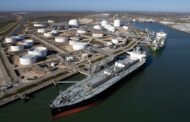


Global oil prices surged on Tuesday as markets reacted to the escalating drone strikes at the Novorossiysk terminal, which handles roughly 2% of the world’s daily supply. The disruption to the Caspian Pipeline Consortium (CPC) infrastructure, a vital artery for Kazakh exports managed by Western majors like Chevron and Shell, raised immediate fears of a prolonged supply squeeze.
WTI was at $60.75, up 2.1%…
While Brent was trading at $65.13, up 1.9%.
Two oil tankers waiting to load crude from some of Kazakhstan’s biggest oilfields were hit by drones at the marine terminal of the Caspian Pipeline Consortium (CPC) near Novorossiysk on Russia’s Black Sea coast, sources told Reuters.
The Caspian Pipeline Consortium Marine Terminal, a major oil export facility close to Novorossiysk, handles most of Kazakhstan’s crude oil exports, as well as some Russian crude supply.
The Delta Harmony and the Matilda tankers were waiting to load crude from Tengizchevroil and Karachaganak, respectively, according to Reuters’ sources.
Tengizchevroil, operating the supergiant Tengiz oilfield in Kazakhstan, is managed by a consortium led by U.S. oil and gas supermajor Chevron. Karachaganak, another giant field in Kazakhstan, is operated by a consortium comprising Shell, Chevron, and Italy’s Eni, among others.
Drone attacks at or near the CPC terminal have intensified in recent weeks and have affected the loading and departure schedules of Kazakhstan’s crude cargoes.
Kazakhstan’s oil output fell sharply at the end of November and early December after damage at the CPC export terminal disrupted flows. Output dropped in the first two days of December after storms and structural damage limited loading capacity at the Black Sea terminal, prompting producers to scale back throughput as storage filled.
Kazakhstan relies on the CPC for roughly 80% of its crude exports.
The disruption came at a sensitive moment for Kazakhstan, which was attempting to stabilize production following repeated CPC interruptions earlier in 2025.
Oil has continued to flow, but at lower rates, while Kazakhstan sought to re-route some exports away from the Black Sea to keep supply relatively steady.
CPC operates the pipeline from the Caspian coast in northwest Kazakhstan to the Novorossiysk port, which handles 80% of Kazakhstan’s crude exports from giant oilfields operated by international oil firms.
Affiliates of Chevron and ExxonMobil are also minority shareholders in CPC, with the Russian Federation as its largest shareholder with a 24% stake.
By Tsvetana Paraskova for Oilprice.com