

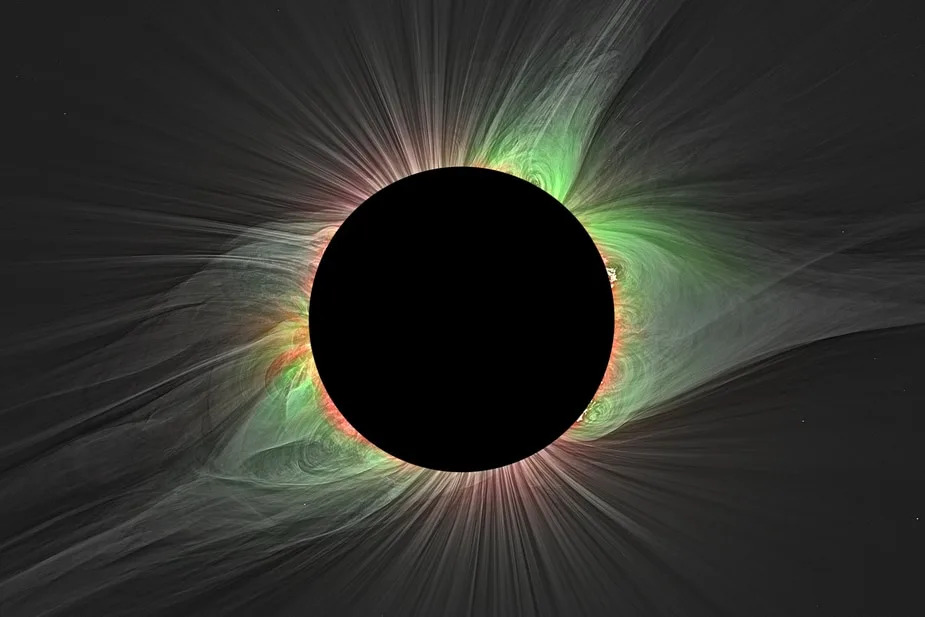
Not all eclipses are created equal.
A solar eclipse is one of the most dramatic and awe-inspiring celestial events a person can witness, but they aren’t all equally impressive. Some are more complete than others and some last only for a moment while others linger.
In the summer of 2027, folks in some parts of the world will be treated to the longest total solar eclipse for a century. Here’s everything you need to know to prepare for the show.
Why eclipses happen, and why they’re always different
Sun Total Solar Eclipse
A solar eclipse happens anytime a moon or other celestial object passes between the Sun and another object or observer. You can see an eclipse from Mars, courtesy of its two potato-shaped moons, Phobos and Deimos. On worlds like Jupiter and Saturn, eclipses can be caused by a great many moons orbiting the gas giants. But no place in the solar system gets eclipses as spectacular as Earth.
Advertisement
Advertisement
In fact, Earth may have better eclipses than almost anyplace in the universe. It has been suggested that if intelligent aliens exist, they might visit Earth just to see a solar eclipse. That’s because of a special relationship between Earth’s Moon and the Sun.
For more on eclipses:
Enjoy Those Total Solar Eclipses While You Can, Because Someday They’ll End Forever
Bill Nye Talks Solar Eclipses and Meeting World-Ending Threats with Hope
Space Station Crew Captures Stunning View of the Eclipse from Space
The Sun is about 400 times larger than the Moon, but it’s also about 400 times farther away, so that their apparent size in the sky is the same. When the Moon fully eclipses the Sun, it perfectly blocks out our star, leaving only its coronal atmosphere visible.
If the Sun, Earth, and the Moon orbited on exactly the same plane, we’d have an eclipse every month during the New Moon, when the Sun and Moon are on the same side of the planet. Unfortunately, that’s not the case. Instead, the Moon’s orbit is inclined about five degrees, so that its shadow often falls above or below the planet. Things line up correctly for an eclipse roughly every six months, during what’s known as eclipse season.
Types of solar eclipses
Types Of Solar Eclipse
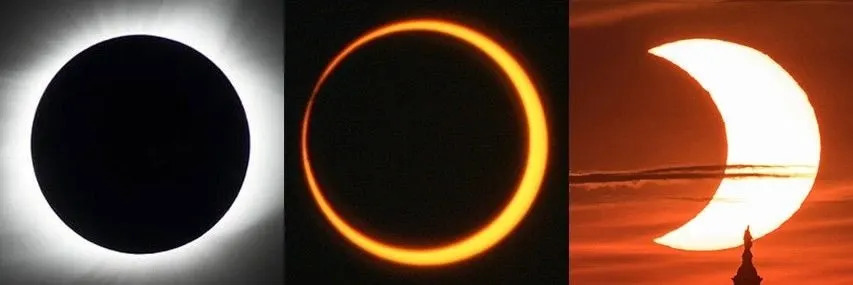
There are three main types of solar eclipse: Total, annular, and partial. A fourth kind, known as a hybrid eclipse, transitions from annular to total, depending on the observer’s location.
Advertisement
Advertisement
How much of the Sun gets covered depends on how the orbits of all three bodies line up. A partial eclipse happens when the lineup is only fleeting. The Moon begins to obscure the Sun and then pulls away again before it can finish the job. It’s never safe to look directly at a partial solar eclipse because part of the Sun always remains visible.
An annular solar eclipse is like a total solar eclipse with one important difference. During an annular eclipse, the Moon is at or near apogee (the farthest point of its orbit), so it appears slightly smaller from our vantage point on Earth. As a result, the Moon lines up with the Sun but doesn’t cover it completely, leaving a visible Ring of Fire around the edges.
Total solar eclipses are the most famous, for their ability to plunge the daylight sky into temporary darkness. Even birds have been known to burst into morning song in the moments following a total solar eclipse. During totality, it’s safe to briefly remove your eclipse glasses and gaze upon the Sun’s coronal atmosphere with the naked eye.
Why the August 2027 eclipse will outshine others
August 27 Solar Eclipse
Even during a total solar eclipse, the length of totality varies from event to event. In April 2024, a total solar eclipse cut across North America. Tens of millions of people along the path of totality enjoyed daytime darkness lasting four minutes 28 seconds. By contrast, a total solar eclipse in August 2026 will last just one minute 43 seconds.
Advertisement
Advertisement
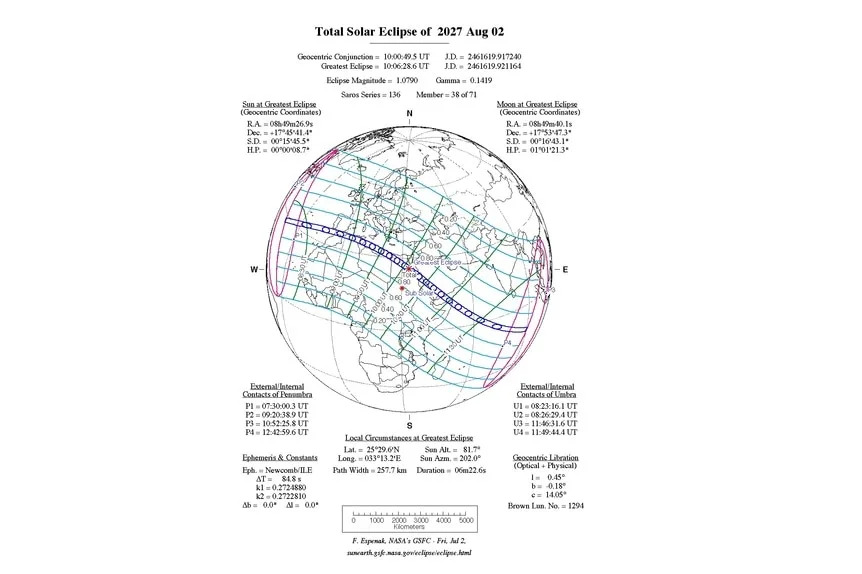
A year later, in August 2027, parts of the world will experience the longest period of totality for a century, lasting six minutes 23 seconds. The February 2026 eclipse will have a longer central duration, seven minutes 51 seconds, but it will be annular, so there will be no totality.
If you want to see the lingering 2027 total solar eclipse, you’ll want to get into the path of totality, which will cut across Spain, Gibraltar, Morocco, Algeria, Tunisia, Libya, Egypt, Saudi Arabia, Yemen and Somalia.
Before you go, check out our eclipse safety guide with Bill Nye the Science Guy.
While you wait, explore the cosmos with The Ark, streaming now on SYFY.